





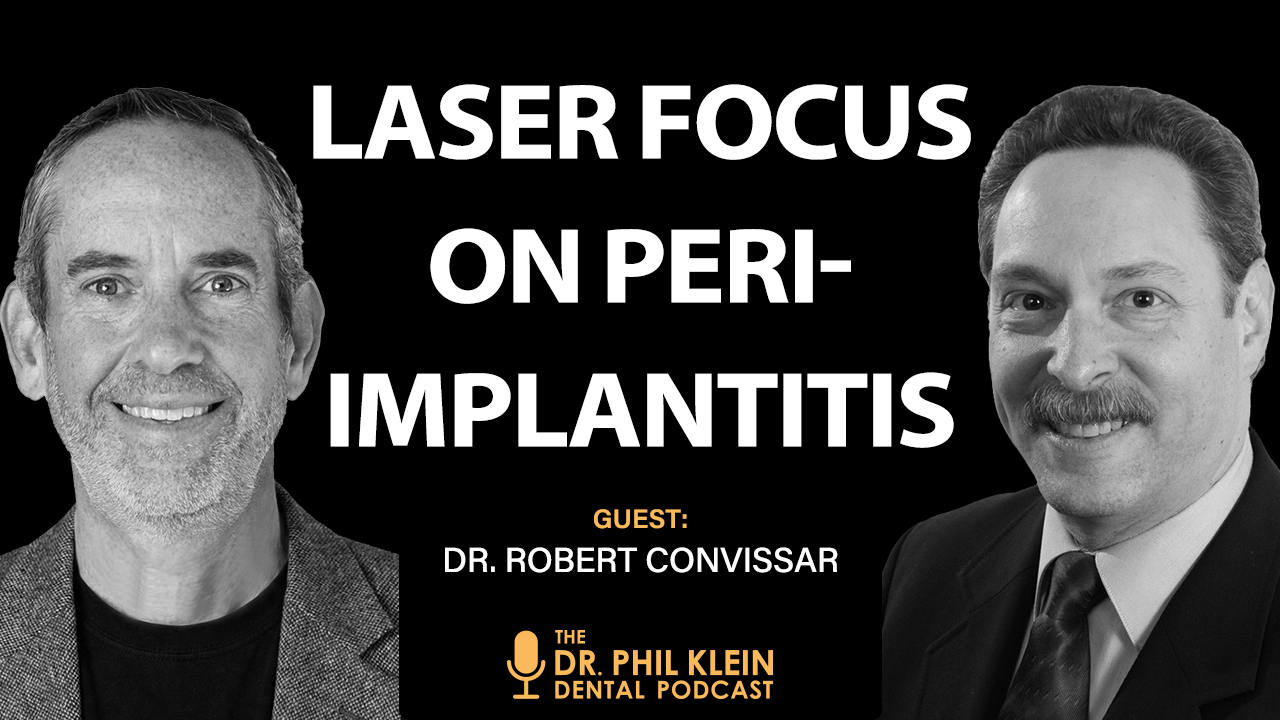
Episode 788: Making the Laser Leap: Implant Care That Pays Off
 |
Are you maximizing your ability to save implants threatened by peri-implant disease? With millions of implants placed annually, peri-implant complications are becoming routine challenges in every practice.
Dr. Robert Convissar brings over four decades of clinical experience and pioneering expertise in dental laser technology to this essential discussion. A New York City-based general practitioner, Dr. Convissar serves as Director of Laser Dentistry at New York Hospital Medical Center of Queens and has authored multiple textbooks including the acclaimed "Principles and Practices of Laser Dentistry," now in its third edition. An international lecturer across 30 countries, he has trained hundreds of dentists in laser applications and oral cancer detection techniques.
This episode provides a comprehensive framework for incorporating laser therapy into peri-implant disease management. Dr. Convissar explains the critical distinction between peri-implant mucositis and peri-implantitis, emphasizing proper diagnosis of etiologic factors before any laser intervention. The discussion covers evidence-based protocols for post-scaling and root planing laser decontamination, optimal wavelength selection, and the essential role dental hygienists can play in laser-assisted therapy.
Episode Highlights:
- Proper etiologic factor identification is mandatory before laser treatment, including evaluation of occlusal loading, crown contours, abutment integrity, and home care compliance. Without addressing these underlying causes, laser therapy provides minimal therapeutic benefit regardless of technique or wavelength selection.
- CO2 and erbium lasers operate at significantly lower tissue temperatures (100°C average tip temperature) compared to diode lasers (750-1500°C), making them safer choices for peri-implant therapy. This temperature differential reduces risk of thermal damage to implant surfaces and surrounding tissues while providing effective bacterial reduction.
- Laser therapy must function as an adjunct to conventional scaling and root planing rather than a replacement. The combination approach provides superior diseased tissue removal and logarithmic bacterial count reduction compared to mechanical debridement alone, leading to enhanced healing outcomes.
- Trained dental hygienists can effectively incorporate laser therapy into maintenance protocols when properly supervised and educated. This delegation expands treatment accessibility while creating additional revenue streams for practices already performing comprehensive peri-implant maintenance.
- Patient acceptance rates for laser-assisted peri-implant therapy are significantly higher than full-mouth periodontal laser treatment due to implant investment protection motivation. Single-implant laser treatment can serve as an introduction to expanded laser therapy applications throughout the mouth.
Perfect for: General dentists, periodontists, oral surgeons, dental hygienists, and practice owners considering laser technology integration for enhanced peri-implant disease management and revenue diversification.
Discover how laser technology can transform your approach to implant preservation and create sustainable practice growth opportunities.
Disclaimer
Viva Learning LLC sites offer content that include opinions, techniques, recommendations, etc. from a variety of writers and speakers that are not necessarily endorsed by Viva Learning LLC, its associates and sponsored Viva Affiliates. Viewers are responsible for verifying the validity, accuracy and relevance of all content before implementing any techniques, products or recommendations into their clinical setting. Viewers understand that Viva Learning LLC, its associates, writers, speakers and sponsored Viva Affiliates are not in any way responsible or liable for any adverse events that may occur (i.e., in a clinical setting or anywhere) based on any information disseminated from Viva Learning LLC sites, including all Viva Learning sites.
The copyrights and other rights to the slides and video contained in a webinar posted on this website are owned by the speaker, Viva Learning LLC, and/or the sponsor company and/or its subsidiaries worldwide. Viewers are only authorized to view the content of the webinar (live and archive) at this Website and are not permitted to screen capture, record and/or download any content displayed in this webinar. You may not make any part of this Website available as part of another web site whether by hyperlink framing on the Internet or otherwise.
The copyrights and other rights to the audio contained in a Viva Podcast are owned by Viva Learning LLC. Viewers are authorized to listen to the content of the podcast and are permitted to download any podcast for personal use only. You may not, however, make any part of this Website available as part of another web site whether by hyperlink framing on the Internet or otherwise.
By signing up for a free webinar and/or podcast you give Viva Learning LLC and/or its Viva Learning Affiliates permission to send you emails alerting you to future CE opportunities and e-learning content.
California State Dental Board Provider Statement
Viva Learning is a registered continuing education provider in the state of CA. Dental Board of CA Provider #RP 5747. Approved through 6/30/2026
Questions regarding our Conditions of Usage, Privacy Policy, or other policy related material can be directed to our support staff by clicking on the "Support" link or you can email us at: support@vivalearning.com.
Approval does not imply acceptance by any regulatory authority or AGD endorsement.
Approval period: 11/1/2025 - 10/31/2029. AGD Provider # 217544
Presenter Information: Dr. Robert Convissar
 |
Dr. Convissar is a pioneer in the field of lasers and one of the world's foremost experts on dental laser technology. One of the first dentists to incorporate lasers into general practice, Dr. Convissar has over two decades of experience with CO2, Diode, Nd.YAG and Erbium wavelengths. An international lecturer from London to Florence to Sydney to Bangkok to Hong Kong and everywhere in between, Dr. Convissar has written four textbooks translated into Spanish, Portuguese, and Greek, and over a dozen peer reviewed papers translated into eight languages. His ground breaking laser treatments have been featured on NBC-TV News, CBS-TV News, the WABC Radio Network, and other programs. Dr. Convissar practices laser, cosmetic and restorative dentistry in New York City with his wife and partner, Dr. Ellen Goldstein. Dr. Convissar also serves as Director of Laser Dentistry at New York Hospital Medical Center of Queens. Dr. Convissar is also an expert in the field of oral cancer detection and biopsy techniques. He has written numerous publications and taught hundreds of dentists how to examine patients for oral cancer, and how to perform biopsies of suspected lesions. Drs. Convissar and Goldstein are among the first dentists in the world to have incorporated the unique “Velscope” oral cancer detection device into general practice. |
Viva Learning is an approved AGD PACE Provider and California State Dental Board Provider of dental continuing education. Viva Learning strives to deliver balanced, objective and clinically relevant information grounded on scientific research. Lecturers who are invited to deliver Viva CE webinars are advised to substantiate their claims with research-supported data and to disclose all commitments to, or relationships with, any commercial entity within the dental industry. In many cases, lecturers are sponsored by a dental manufacturing company, which provides them with support in the form of honorarium and/or dental products and equipment in order to help with clinical presentations. Prior to each live CE webinar, lecturers are made aware of the importance of delivering their presentations without commercial bias, and where appropriate, to mention a variety of different product choices that may be relevant to the subject matter of the lecture, for the educational benefit of the participant.
Transcript
do everything you can possibly do with it, and then if you decide you want to do airway, you can
add the accessories, add the hand pieces to the laser. You don't have to junk it and buy a whole
new laser.
Welcome to Austin, Texas, and welcome to the Phil Klein Dental Podcast. So what can a dental laser
really do when it comes to treating peri-implant mucositis and peri-implantitis? What type of
laser works best? Can your hygienist play a role in laser-assisted care? And how might this all
impact your bottom line? And what kind of training are we looking at as far as becoming competent
in using a dental laser? And what's the return on investment after purchasing a laser? To answer
these questions is our guest, Dr. Bob Convissar. a gp with over 40 years of clinical experience
based in new york city dr conversar maintains a private practice and lectures globally on laser
surgery biopsy techniques and infant tongue-tie release He's also the author of more than a half a
dozen textbooks, including the highly respected Principles and Practices of Laser Dentistry,
now in its third edition. Before we bring in our guest, I do want to say that if you're enjoying
these episodes and want to support the show, please follow us on Apple Podcasts or Spotify.
You'll be the first to know about our new releases, and our entire production team will really
appreciate it. Dr. Convissar, welcome to the show. My pleasure. Great to be here. So before we get
into the details of using a dental laser for periimplantitis and periimplant mucositis,
tell us the difference between those two conditions. Most of our listeners know it already, but as
a review. I'll give you an analogy very, very roughly. What's the difference between gingivitis and
periodontitis? Gingivitis is mostly a soft tissue problem. periodontitis is a soft tissue and a
hard tissue problem where you have bone loss. Same thing with perimucositis versus perimplantitis.
Perimucositis is an inflammation of the soft tissue, whereas perimplantitis is an inflammation or
infection of the soft tissue and the hard tissue where you have some bone loss as a result of the
infection. So two different diseases, two different treatment modalities, and we need to discuss.
when you do what for which disease. Right. And one of the most important things between the two is
that periimplantitis, when it does get that far, progresses at a much more rapid rate than
periodontitis because we don't have any Sharpies fibers there defending ourselves to some extent,
right? Correct. There's no connective tissue between the implant and the bone. Right. It's a
complete adhesion between the... titanium oxide in the bone. And that's lost.
And when it's lost, it's lost. Back in the day, we didn't see a lot of peri-implantitis because we
didn't see a lot of implants. But we've been installing three to five million implants a year now.
So just by large numbers, we're going to see... these kinds of cases routinely in our practice,
right? The hygiene bay is going to be seeing patients that have redness around their implant.
They're going to be doing some gentle probing around the implant and they're going to see some
pocket depth, which doesn't have to be as deep as... periodontitis right some of the peri
implantitis can be pretty aggressive in the early stages but not show six millimeter pockets right
they could be four millimeter pockets so these are the kind of things you have to be aware of so
you're an expert on lasers you've written a book on it now in its third edition hats off to you and
i know gordon christensen wrote the uh forward forward yeah which is really impressive so Tell us
how lasers can be instrumental in the treatment of, let's start with peri-implant mucositis first.
Well, the first thing is to figure out what the problem is before we even pick up the laser. Why is
there perimucositis there? What's the etiologic factor? And I've spoken to more periodontists and
oral surgeons and implantologists than you can shake a stick at. And what do they say are the
biggest problems? Number one, improper occlusal loading. Very,
very often, that's a huge part of the problem, occlusal prematurities. Number two, the contour of
the implant crown. When lab technicians make implant crowns, they will make a point contact or a
relatively short contact gingival occlusally when you need a much,
much longer contact gingival occlusally. One of the things that we didn't discuss as an etiologic
factor is a loose abutment, a loose screw. And when that happens and the crown itself starts to
move around a little bit, that can cause tremendous, tremendous problems. So once again, before you
take out the laser, before you take out your scalpel, before you take out anything, find the
etiologic factor. If the screw is tight, there's no movement of the abutment. There's no movement
of the crown. The contours are perfect. You have good contacts.
You have nice small embrasures. You've got all that stuff. Home care is number one.
Home care is number two. Home care is number three. And then if there's no significant improvement,
you use the laser once again as a last resort, as an adjunct to rather than a replacement.
And you try and treat it that way. Lasers are wonderful devices for bacterial eradication.
But if the etiologic factor isn't necessarily bacterial. it's the loose abutment or whatever,
then the laser is not going to do a whole heck of a lot. So you've got to figure out what's going
on before you treat it. We'll be getting right back to our guest in a second, but first... When it
comes to digital workflow equipment, it's important to partner with companies that provide premium
products with unparalleled service, all at an affordable price. That's why you should check out
Shining 3D Dental, a company that offers a complete and integrated suite of high quality and easy
to use digital dental equipment. Their local offices are based in California and Florida, so you
get in-time comprehensive support. In fact, Shining 3D Dental can furnish your office with an
entire suite of digital for under $27,000. This includes their AoralScan3 wireless intraoral
scanner, Metasmile 3D facial scanner, and the Acufab 3D printer with its post-processing
equipment. Plus, the Shining 3D Dental Digital Workflow solution includes cloud storage,
synchronization, and software for consultation, analysis, and design. So whether you're taking your
first step into digital dentistry or you're looking to add additional equipment, check out Shining
3D Dental. Dental's complete digital dental portfolio. To learn more, visit shining3ddental.com.
We've discussed at length, Dr. Convissar, that the dental laser is a great adjunct, but you have to
have SRP first. And after SRP is done, then you can proceed to using the laser to decontaminate the
pocket, which promotes healing and is clinically beneficial that way. Tell us exactly on the tissue
level what the laser is doing as an adjunct to SRP. Well, one of the things that a laser,
particularly a CO2 or an erbium, can do is they're absorbed by water in the soft tissue.
And when you have perimucositis, the tissue is red, the tissue is inflamed, the tissue is
edematous, the tissue is hyperemic. So that is something that is going to be treated absolutely
perfectly by the laser. The laser will draw out the water, will decrease the swelling, will
decrease the hyperemia. decrease all of those things and bring the mucosa back to a state of health
only under two conditions. Number one, the patient can keep the area clean.
And number two, you've checked the occlusion and virtually any period. or peri-implant protocol,
occlusal equilibration is one of the most critical things. But assuming the occlusion is perfect,
the patient's home care... Has to be perfect, has to be spot on. And then you use a CO2 or an
erbium, they both work well, to decrease the swelling in the tissue, decrease the bulk of the
tissue, and make the area more self-cleansable so the patient can use their toothbrush,
their floss, their proxy brushes, their whatever you want to give them. And I do want to reiterate
that scaling and replaning is a prerequisite to using a laser to decontaminate the soft tissue.
Without question, the laser is always used in addition to rather than in place of.
And I'll say that again, because that's critically important. And it's a huge mistake that novice
laser users make. Use the laser in addition to rather than in place of.
Assuming you don't have the laser, how are you going to attack the problem? You're going to attack
the problem with scaling, with replanting, with occlusal equilibration, with giving the patient
whatever ammunition they need to keep the area cleansable. If you have a laser, you do all of those
things. And then use the laser as an additional, as an adjunct to everything else you've used.
The laser is not a magic wand. It can't work in a vacuum. You've got to use it along with more
conventional modalities. And I think it should be pointed out, Dr. Convissar, that patients can
come in with redness around the implant, mucositis, and the rest of the perinatal health is
excellent. Yeah, that can happen from time to time where it's just an... problem with the implant,
not with the rest of the teeth. And then once again, you have to look at the etiologic factors.
Why is it that the patient has peri-implant disease, but not periodontal disease?
It could be the placement of the implant, the angle of the implant. It could be cement. It could be
cement, absolutely. It could be occlusal overload. It could be over-contouring of the crown.
It could be any of a whole bunch. of things and once again all of those things need to be addressed
in addition to using the laser because the laser is wonderful in treating the pathology but you've
got to understand what's causing the pathology first and get to a treatment of that as well so what
do you say to a dentist who claims their hygienists are fantastic which they probably are and the
srp is getting fantastic results the gingiva is healthy they're getting good responses patients are
complying at home You know, is the juice worth the squeeze when it comes to purchasing a laser for
post-SRP procedures? In other words, what actually is the laser doing that SRP cannot do?
What the laser is going to do much more effectively and efficiently is it will be better at
removing the disease tissue than a cure-at. That's been shown in dozens of studies. And once that
disease tissue... is removed, you then have the body's own immune system being able to start to
heal that. The other question, of course, as to what a laser can do is lasers are bactericidal
instruments. So it's going to logarithmically decrease the bacterial content.
And if you remember your old microbiology, you're decreasing significantly the number of CFUs,
the number of colony forming units in the pocket. So once you have a tremendous decrease in the
number of bacteria in the area, which the laser will do without question, and you have a more
complete eradication of the diseased tissue, meaning that the diseased tissue is gone and the
bacteria within the diseased tissue is gone, you'll have a superior therapeutic result. And from
knowing you for a number of years, Dr. Convissar, I know you're a big proponent of dental
hygienists utilizing laser therapy in their dental hygiene appointments. Without question.
I have no problem whatsoever with a skilled, trained, trained, trained hygienist using the correct
laser the correct way. Yeah. And I know we talked about this on other episodes, but I think it's
important to reiterate it. Talk to us about the CO2 laser. It seems to me that that laser is the
safest. It operates at a cooler level, right? It doesn't raise the temperature of the tissue up
like a 980 nanometer. laser, a diode. Tell us about that because a diode is much cheaper.
It costs a whole lot less. And if a dentist wants to buy one laser after talking with you about
this, it seems like CO2 is the way to go. Without question. In my office, I have about 15 lasers.
I have diodes, NDX, erbiums, CO2s, PBMs. I've got plenty of lasers. My go-to without question is
the CO2. The reasons for that would take up a whole podcast by itself.
One of the biggest reasons, is that the average tip temperature of a diode, according to the peer
-reviewed literature, not according to me, according to the peer-reviewed literature, is the
average tip temperature of a diode is 750 to 1500 degrees Celsius. The average tip temperature of a
CO2 or an erbium is 100 degrees Celsius. So what you're doing with the CO2 is you're vaporizing
tissue at a relatively low temperature compared to a diode at 750 to 1500 degrees.
a remote possibility but the possibility is not zero of exacerbating the problem by depositing so
much heat not necessarily on the implant but on the surrounding soft tissue because what's going to
happen to that heat when you heat up the soft tissue that heat is going to convect over to the
implant and it will heat up the implant without question. So on a previous podcast, Dr.
Convissar, we talked about an additional revenue stream using a CO2 laser for non-surgical
periotherapy following SRP. And I think it's a great clinical benefit as the literature shows,
but to get patients to agree on a full mouth treatment like that is challenging to some extent
because the insurance companies don't pay for it. But in this case, when you're using a CO2 laser,
for instance, to treat mucositis after SRP, it seems like patients would be more willing to do that
and pay for that treatment out of their own pocket since they've already invested in that implant.
So they want to protect their investment. Is that what you're finding? We'll be getting right back
to our guest in a second. But first, when it comes to the final step in indirect restorations,
cementation is crucial. That's why thousands of top clinicians rely on Therisem by Bisco.
This dual-cured calcium and fluoride-releasing self-adhesive resin cement is ideal for looting
crowns, bridges, inlays, and onlays, with no need for a primer. TheraseM forms a strong bond
directly to zirconia in most dental substrates. Its easy cleanup, convenient delivery system,
high radio opacity, and continuous calcium and fluoride release make TheraseM a top choice among
dental cements. For cases where you choose to apply an adhesive separately, Duolink Universal
Adhesive Resin Cement is the perfect solution. Compatible with all dental materials, it works
seamlessly with Bisco adhesives, such as Z' Plus and Porcelain Primer, ensuring optimal strength
and adhesion. It's time to get the most out of your indirect restorations with Bisco's Advanced
Dental Cements. To learn more, visit bisco.com. I agree 100%.
If somebody has gone through it, especially take a look at a maxillary posterior implant,
they may have had a sinus lift and they've had the implant placement and they've had a bone graft
and they've had all of those procedures to get the site ready and then the implant is placed and
then they've had a custom abutment and then they've had a crown. That's a considerable amount of
money. And if it is in danger of being lost, the patient looking at.
A second bone graft, a second abutment, a second crown,
a second everything. And that's going to make it prohibitively expensive for some people. And if I
can take my trusty laser in addition to, rather than in place of, in addition to my conventional
bag of trip. tricks, scaling, root planning, home care, maybe arrestin, maybe chlorhexidine chips,
definitely occlusal equilibration, and I can get success in treating that, then the patient is
going to be much, much more likely to accept that treatment plan rather than, okay, let's take out
the implant and start from the beginning and maybe be without a tooth for six months to a year or
more because we have to let the bone graft heal. Yeah. And then in most cases, I would assume that
patient would accept laser. post-SRP laser treatment for the entire mouth,
not just where the implants are. So you're looking at a $5,000 and upward fee for that, which is
cash, right? You don't have to worry about getting it from the insurance company. Correct.
Absolutely. So based on the fact that there are so many implants out there, and peri-implantitis
is becoming much more prevalent now because of that, just on the law of large numbers, it seems to
me it would make sense for every GP to have a laser, especially a CO2 laser. Absolutely,
without question. It's just not a matter of buying a laser. It's a matter of getting trained to use
the laser, getting trained the right way to understand all the things that the laser can do.
Also understand the limitations of the laser. and then take it from there. I couldn't practice
without my lasers. If my lasers were not working, I would just close up shop for the day.
They are as vital to me, even more so than my handpiece. So let's talk about the ROI for a minute.
What's the best way to get started with a laser? Should we lease it? Should we buy it? The best way
to pay for a laser is the way your accountant tells you to do it. That's not my area of expertise.
Most dentists will just take a five-year lease with a dollar buyback. So after the five years the
lease is up, they pay a dollar and the laser is there. Other dentists that are a little older that
have a nice amount of money in their pension plan or IRA or whatever, they can take a loan against
their pension plan, pay for the laser that way, and then pay themselves. back into the pension
plan. That's another way. Some people may decide they just want to do it in one lump sum.
So typically, what is a good CO2 laser cost these days? Depends on what you want to do with it.
A basic plain vanilla CO2 is going to be somewhere, and don't quote me because I don't sell lasers,
somewhere in the range of about $40,000, give or take. $40,000.
$40,000, give or take. And then, of course, if you want to start doing snoring and sleep apnea,
you want to start doing facial aesthetics, you want to do a whole bunch of other things like that,
then you need different accessories and different hand pieces, and that can bring the price up. But
for a plain vanilla average GP that doesn't want to get involved with airway dentistry, snoring,
sleep apnea, stuff like that, somewhere in the range of about $40,000 should be more than adequate
to get a perfect quality, an excellent quality CO2. And there are some very... very good ones out
there. So let's talk about the claims that different laser companies market.
How accurate are these claims and how much attention should the dentist as the buyer pay to the
claims that are being promulgated by these laser companies? That's a great question. And that's
going to get me in trouble with the laser companies, but I don't care because they don't pay me.
You're a free man. You're a free man, Dr. I'm a free man. I don't take a... from laser companies to
promote anything i've been doing this since 1989 and if i have to start to take money from laser
companies to promote their uh their products i might as well just shoot myself so that's that's not
happening um most laser companies are run by um how do i say this gently liars and thieves um yeah
that's that's worse than i thought yeah Yeah, that's a little extreme. They're not.
They're very nice people, but they want to sell a product. So are they going to overhype and
underdeliver? Yeah, probably. Are they going to talk about how great their laser is and how lousy
other lasers are compared to theirs? Yeah, probably. That's why.
Once again, when you take a course, it's got to be a course with multiple laser wavelengths or
multiple laser companies there. A good way to start is the textbook principles and practice of
laser dentistry that I'm very, very proud of. There's a whole chapter on laser physics,
laser tissue interaction, how these things work. And once you understand how these things work,
it'll help you decide. on what you want to do and how you want to do it and then you go chapter by
chapter if you want to do perio if you want to do endo if you want to do fixed if you want to do
removable you just read the book chapter by chapter and figure out what you want to do how you want
to do it how difficult and boring is the reading is it tolerable because you say textbook when
people say textbook a lot of dentists don't want to read it Well, I've been practicing dentistry
for a very long time, and the thing I have to tell you about the book is that there are over 1,200
pictures. That helps. That makes it very, very easy. If you don't want to read the book,
just take a look at all the pictures and take a look at the captions of the pictures, and that'll
give you a pretty good idea of what to do and how to do it. The way things are now, and I know
we're a little bit older than the generation that... were born with a phone in their hand.
That's insulting, but true. Yeah, it's true. But we're still at it. Listen, you're busy. I'm
running a company here. I got Viva Learning behind me. My son is doing a lot of stuff here. But
what is very interesting is that a lot of dentists, even though they're dentists, they're still
part of the younger generation, they go to YouTube and they want to see a video on it. And listen,
whenever my son needs to fix something or replace something, there's always a video, the most
esoteric, ridiculously far-out procedure that he needs to do around the house,
he could find a video on it. Some guy posted a video on it. It's crazy. Some of it's good,
and it's buyer beware. But my suggestion is to some of these dentists that are interested in
exploring the opportunity of a dental laser, which I hear so much about, is to take a course by you
or someone like you and maybe have the textbook as a reference.
And then as they get more into it and understand where they are, they can use that textbook and
they'll have it handy. Or if they're really gung-ho and they're nerds, they can read it before
they see you. But the point is, everyone needs a mentor because you have so many decades of
experience, Dr. Convissar. You've made your mistakes. You know which patients benefit from what.
There's nothing more valuable than decades of clinical experience. The lasers came out,
what, in 1964? The first lasers were invented in 64. They didn't come into general dentistry until
1989. When did you start using it? 1989. What got you involved with lasers so early?
I had always tutored kids in high school. I tutored kids for the SATs in college.
I tutored kids for the DATs in dental school. I tutored kids for the National Dental Boards Part 1
and 2. I enjoy teaching. And when the first laser came out in 1989,
I said, you know what, this would give me an opportunity to get back to my roots,
to teaching people. And I bought the first laser, got in on the ground floor.
And it was the best thing I ever did. Amazing, amazing. Yeah, you've done so many things with
lasers. Besides the teaching and the writing, you've influenced so many people. And it's really an
honor to have you on the show. I really hope that some of the dentists that are listening to this
program email you, ask you where your course is. And again, we don't have any financial interest in
whether you take a course by Dr. Convissar or not. None, zero, zilch. As far as I could tell,
based on my knowledge of Dr. Convissar over a long time now, he's so excited and passionate about
lasers that... infectious, and I can't imagine that anybody that takes a course with him will not
come out of there with the same excitement. So it is worth looking into. And again, one of the most
important things, correct me if I'm wrong, Dr. Convissar, is that lasers open up the doors to other
services in your practice. Like we said, airway. Infant tongue tie. You said that the ROI on infant
tongue tie, if you do what, one a month? One a month. It covers the lease payment. easily easily
and that one of the other things i want to talk about the courses is i don't get paid per person so
if there are 10 people in the course or 100 people in the course it doesn't matter that doesn't
affect me in any manner shape or form i get paid by the venue um And the venue pays me no matter
how many people are there. So I'm not promoting the courses to put more money in my pocket. The
courses are always there. The courses always sell out. And I'd love to have anyone and everyone
come and learn. And even people that have lasers and the lasers are sitting in the corner and the
lasers are being used once or twice or three times a week, please come to the course and you'll
learn how to use that laser. Whatever wavelength it is, you'll learn how to get so much more out of
it. much happier with it. Yeah. And besides helping the patient, it's a great revenue stream.
It's an additional... Without question. Yeah. It's an additional revenue stream. So as we wrap it
up, Dr. Convissar, I know you're very open to answering questions via email. So if you would tell
our audience what your email is, and I'm sure you'll get some email questions from our listeners.
laserbobdds at gmail. L-A-S-E-R-B-O-B-D-D-S, laserbobdds at gmail.
So please email me any question. There's no such thing as a dumb question. Any questions, I spend
about an hour a day, virtually every single day, answering questions from people all over the world
that have taken my courses, that want to know more information. I've lectured in about 30
countries, hundreds of cities. So I've got people following me from the world over.
So please email me and I will give you the facts and I will not be selling you anything.
Thank you very much, Dr. Convissar. Have a great evening. We appreciate your insight. Thank you.
Great to be here.
 Episode 788. Making the Laser Leap: Implant Care That Pays Off
7/23/2026 - CE Credits: 0.5 CEU (Take Exam)
Episode 786. When Dental Patients Use HIPAA for Leverage and Retaliation
7/16/2026 - CE Credits: 0.5 CEU (Take Exam)
Episode 784. Implant Rescue: Non-Surgical and Surgical Treatment of Peri-implantitis
7/9/2026 - CE Credits: 0.5 CEU (Take Exam)
Episode 782. Pairing Perfect Impressions With The Exceptional Patient Experience
7/2/2026 - CE Credits: 0.5 CEU (Take Exam)
Episode 780. Know When to Let Go: Hiring Your Next Office Manager
6/25/2026 - CE Credits: 0.5 CEU (Take Exam)
Episode 778. Do Dentists Really Need to Advertise? A Practical Look at ROI
6/18/2026 - CE Credits: 0.5 CEU (Take Exam)
Episode 776. Attract, Convert, Deliver, Collect: NYC Prosthodontist Dr. Giglio Shares His Secret Sauce
6/11/2026 - CE Credits: 0.5 CEU (Take Exam)
Episode 771. Posture, Pain, and Prevention: The Ergonomics Wake-Up Call for Dental Professionals
5/21/2026 - CE Credits: 0.5 CEU (Take Exam)
Episode 769. Prescribing Nutrition: A Game Changer for Immediate Denture Outcomes
5/14/2026 - CE Credits: 0.5 CEU (Take Exam)
Episode 767. From Overwhelmed to Empowered: Taking Control of Your Dental Practice and Career
5/7/2026 - CE Credits: 0.5 CEU (Take Exam)
Episode 765. How a NYC Prosthodontist Built a High-Trust, High-Value Practice
4/30/2026 - CE Credits: 0.5 CEU (Take Exam)
Episode 763. From Burnout to Balance: Reclaiming Your Energy and Purpose in Dentistry
4/23/2026 - CE Credits: 0.5 CEU (Take Exam)
Episode 761. From Online Visitor to Booked Appointment: Dental Website Strategies That Work
4/16/2026 - CE Credits: 0.5 CEU (Take Exam)
Episode 759. From Diagnosis to Growth: A GP’s Success Story with CBCT
4/9/2026 - CE Credits: 0.5 CEU (Take Exam)
Episode 757. Antibiotic Resistance: Smarter Prescribing in Dental Care
4/2/2026 - CE Credits: 0.5 CEU (Take Exam)
Episode 755. Concerned Team Member Triggers OSHA Nitrous Oxide Inspection
3/26/2026 - CE Credits: 0.5 CEU (Take Exam)
Episode 753. The Rise of DIY Dentistry on Social Media: Why it Matters
3/19/2026 - CE Credits: 0.5 CEU (Take Exam)
Episode 751. Bridging the Dentist-Hygienist Gap: Comprehensive Care Starts in the Hygiene Chair
3/12/2026 - CE Credits: 0.5 CEU (Take Exam)
Episode 749. Why Every GP and Hygienist Should Be Using a Dental Laser
3/5/2026 - CE Credits: 0.5 CEU (Take Exam)
Episode 747. Breaking Free: Escaping Corporate Dentistry and Creating a Practice You Love
2/26/2026 - CE Credits: 0.5 CEU (Take Exam)
Episode 745. Clear Aligner Therapy: Treating Adult Lower Anterior Crowding the Right Way
2/19/2026 - CE Credits: 0.5 CEU (Take Exam)
Episode 743. How a Dentist Transformed Her Career with an AI-Driven, Remote-Staffed Practice
2/12/2026 - CE Credits: 0.5 CEU (Take Exam)
Episode 741. What Can Doom Your Implants? Uncovering the Risks of Implant Failure
2/5/2026 - CE Credits: 0.5 CEU (Take Exam)
Episode 739. Seal the Deal: Perfecting Rubber Dam Placement in Endodontics
1/29/2026 - CE Credits: 0.5 CEU (Take Exam)
Episode 738. Retain Your Dental Team by Fostering a Culture of Health and Wellness
1/26/2026 - CE Credits: 0.5 CEU (Take Exam)
Episode 737. The Blue Light Hazard in Dentistry: What You Need to Know
1/22/2026 - CE Credits: 0.5 CEU (Take Exam)
Episode 735. Treating the Avulsed Permanent Incisor with Partially Formed Root
1/15/2026 - CE Credits: 0.25 CEU (Take Exam)
Episode 732. Sterilization Breakdown: A Dentist's Shocking Discovery and its Aftermath
1/5/2026 - CE Credits: 0.25 CEU (Take Exam)
Episode 729. When the Attorney General Comes Knocking: IC Violations and Your Dental Practice
12/18/2025 - CE Credits: 0.25 CEU (Take Exam)
Episode 727. How Dental Partnership Groups Reshape Dental Practice Ownership
12/11/2025 - CE Credits: 0.25 CEU (Take Exam)
Episode 725. Start Before You’re Ready: Dr. Cohn’s Bold Path in Pediatric Dentistry
12/4/2025 - CE Credits: 0.5 CEU (Take Exam)
Episode 722. Proper Prevention and Response to an Eye Incident in Your Operatory
11/20/2025 - CE Credits: 0.5 CEU (Take Exam)
Episode 718. Medical Reimbursement for Dentists: What You Need to Know
11/6/2025 - CE Credits: 0.5 CEU (Take Exam)
Episode 716. Muscle Strengthening: A Better ROI than Disability Insurance
10/31/2025 - CE Credits: 0.5 CEU (Take Exam)
Episode 714. Airway & TMJ: The Competitive Edge for Your Practice and Career
10/23/2025 - CE Credits: 0.5 CEU (Take Exam)
Episode 712. When Patients or Employees File Complaints: What Dentists Need to Know
10/16/2025 - CE Credits: 0.5 CEU (Take Exam)
Episode 710. The Tech-Savvy Hygienist: Navigating AI and Innovation
10/9/2025 - CE Credits: 0.25 CEU (Take Exam)
Episode 708. In-House Milling & 3D Printing: Making the Right Call for Your Practice
10/2/2025 - CE Credits: 0.5 CEU (Take Exam)
Episode 706. Thriving, Not Surviving: How Dentists Can Stay Passionate and Avoid Burnout
9/25/2025 - CE Credits: 0.5 CEU (Take Exam)
Episode 704. Infection Control and Employee Whistleblowing
9/18/2025 - CE Credits: 0.5 CEU (Take Exam)
Episode 703. The Right Fit: Delivery Systems and Ergonomics in Dentistry
9/15/2025 - CE Credits: 0.25 CEU (Take Exam)
Episode 700. Finding and Retaining Your Ideal Dental Office Manager
9/4/2025 - CE Credits: 0.5 CEU (Take Exam)
Episode 698. Navigating Oral Ulcerative Conditions: When to Treat, Refer, or Reassure
8/28/2025 - CE Credits: 0.25 CEU (Take Exam)
Episode 696. The Truth About Mouthwashes, Molecular Iodine & More: Insights from a Periodontist
8/21/2025 - CE Credits: 0.25 CEU (Take Exam)
Episode 694. The Rise of Fractional Dental Executives: A Conversation with Melissa Turner, RDH
8/14/2025 - CE Credits: 0.25 CEU (Take Exam)
Episode 692. Code & Collect: Unveiling the Secrets of Medical Billing Benefits
8/7/2025 - CE Credits: 0.25 CEU (Take Exam)
Episode 690. Beyond the Chair: Why Teledentistry is So Important to Your Practice
7/31/2025 - CE Credits: 0.25 CEU (Take Exam)
Episode 688. From Files to Photons: How Lasers Improve Cleaning & Success Rates
7/24/2025 - CE Credits: 0.25 CEU (Take Exam)
Episode 686. Patient Owes You Money and Wants Their Dental Records: HIPAA Rules!
7/17/2025 - CE Credits: 0.25 CEU (Take Exam)
Episode 684. Dental Career Longevity: A Little Fitness Each Day Goes a Very Long Way
7/10/2025 - CE Credits: 0.5 CEU (Take Exam)
Episode 682. Airway Sleep Dentistry in the Pediatric Population
7/3/2025 - CE Credits: 0.25 CEU (Take Exam)
Episode 680. The Nuts and Bolts of Root Resorption and How to Treat It
6/26/2025 - CE Credits: 0.5 CEU (Take Exam)
Episode 678. Teledentistry: Integrating Virtual Care into Your Practice
6/19/2025 - CE Credits: 0.5 CEU (Take Exam)
Episode 676. The Hidden Dangers of Leukoplakia: What Every Dentist Should Know
6/12/2025 - CE Credits: 0.25 CEU (Take Exam)
Episode 674. Forging Frontiers: Seizing Dental Opportunities in a New Locale
6/5/2025 - CE Credits: 0.25 CEU (Take Exam)
Episode 672. Profitable Care: Financial Benefits of Medical Management of Caries
5/29/2025 - CE Credits: 0.5 CEU (Take Exam)
Episode 670. Dental Hygiene: Top 5 Things No One Told Me in School
5/22/2025 - CE Credits: 0.5 CEU (Take Exam)
Episode 669. Reaching the Unreachable: Killing Microbes in Lateral and Accessory Canals
5/19/2025 - CE Credits: 0.5 CEU (Take Exam)
Episode 668. Ergonomic Excellence: Positioning Strategies for Dentists and Patients
5/15/2025 - CE Credits: 0.25 CEU (Take Exam)
Episode 666. Protect Against Peri-Implantitis: Kill the Bugs in the Implant Channel
5/8/2025 - CE Credits: 0.25 CEU (Take Exam)
Episode 664. Treating the Avulsed Permanent Central with Fully Formed Root
5/1/2025 - CE Credits: 0.25 CEU (Take Exam)
Episode 662. The Worn-Down Currette: Retip, Sharpen, or Replace?
4/25/2025 - CE Credits: 0.25 CEU (Take Exam)
Episode 660. Medical Management of Caries: Demystifying the Use of SDF and Glass Ionomer
4/17/2025 - CE Credits: 0.25 CEU (Take Exam)
Episode 658. Full Coverage Crowns on Primary Teeth: Pros, Cons, and Best Practices
4/10/2025 - CE Credits: 0.5 CEU (Take Exam)
Episode 656. Preparing Ourselves For an Injury-free Career in Dentistry
4/3/2025 - CE Credits: 0.25 CEU (Take Exam)
Episode 654. Why Clinical Technique Is Key to Intraoral Scanner Accuracy
3/27/2025 - CE Credits: 0.5 CEU (Take Exam)
Episode 652. From Complaints to Compliance: Mastering OSHA Inspections
3/20/2025 - CE Credits: 0.5 CEU (Take Exam)
Episode 650. Simple Ways to Redefine Your Dental Practice Through Superior Service
3/13/2025 - CE Credits: 0.25 CEU (Take Exam)
Episode 646. From Kansas City to Wichita: A Dentist’s Journey to Fulfillment
3/1/2025 - CE Credits: 0.25 CEU (Take Exam)
Episode 645. Employee Impact on Dental Practice Success
2/26/2025 - CE Credits: 0.25 CEU (Take Exam)
Episode 644. Are You Sure Your Instruments Are Ready for Sterilization?
2/24/2025 - CE Credits: 0.5 CEU (Take Exam)
Episode 643. Infection Control and Prevention: The Devil is in the Details; A Discussion with Emily Boge
2/19/2025 - CE Credits: 0.5 CEU (Take Exam)
Episode 641. Where Are the Hygienists? Tackling the Dental Staffing Deficit
2/12/2025 - CE Credits: 0.25 CEU (Take Exam)
Episode 639. The Initial Scan Visit: Building Strong Patient Relationships Digitally
2/5/2025 - CE Credits: 0.5 CEU (Take Exam)
Episode 637. Common Oral Pathologies: Best Practices for Dental Professionals
1/30/2025 - CE Credits: 0.5 CEU (Take Exam)
Episode 635. Building a Winning Dental Team Without Being a Natural Leader
1/22/2025 - CE Credits: 0.25 CEU (Take Exam)
Episode 633. Brace for Impact: Buying a Practice that's not OSHA Compliant
1/15/2025 - CE Credits: 0.5 CEU (Take Exam)
Episode 629. Printed Efficiency: Revolutionizing Your Practice with a 3D Printer
1/2/2025 - CE Credits: 0.25 CEU (Take Exam)
Episode 628. High-Frequency Healing: Revolutionizing Endodontic Disinfection
12/30/2024 - CE Credits: 0.5 CEU (Take Exam)
Episode 627. Endodontic Irrigation: Power-flushing Your Way to Success
12/24/2024 - CE Credits: 0.25 CEU (Take Exam)
Episode 624. Oral HPV Testing: A New Dental Approach to an Old Problem
12/9/2024 - CE Credits: 0.25 CEU (Take Exam)
Episode 623. Emergency Action Planning for Violent Incidents in Dental Facilities
12/4/2024 - CE Credits: 0.25 CEU (Take Exam)
Episode 621. 3D Facial Scanners, 3D Printers, AI and How to Transition Into a Digital Practice
11/27/2024 - CE Credits: 0.25 CEU (Take Exam)
Episode 616. Stop Giving CT's Away and Bill to Medical Insurance!
11/11/2024 - CE Credits: 0.25 CEU (Take Exam)
Episode 615. Women in Dentistry: From Practice to Podium
11/6/2024 - CE Credits: 0.25 CEU (Take Exam)
Episode 613. Beyond the Smile: Embracing an Overall Wellness Approach to Dentistry
10/31/2024 - CE Credits: 0.25 CEU (Take Exam)
Episode 611. A Periodontist Shares His Secret Sauce For Successful Perio Outcomes
10/24/2024 - CE Credits: 0.25 CEU (Take Exam)
Episode 608. Making the Jump from Insurance-based to Fee-for-Service
10/9/2024 - CE Credits: 0.25 CEU (Take Exam)
Episode 606. Beyond City Limits: Dentistry in Rural America
10/2/2024 - CE Credits: 0.5 CEU (Take Exam)
Episode 604. Increasing Violence in the Dental Workplace – What Would You Do?
9/25/2024 - CE Credits: 0.25 CEU (Take Exam)
Episode 602. Intra-oral Scanners: Rely on Your Team, Get Perfect Impressions and Reduce Your Chair Time
9/18/2024 - CE Credits: 0.25 CEU (Take Exam)
Episode 601. Attract, Convert and Deliver: Reliable and Efficient Systems in Your Practice
9/16/2024 - CE Credits: 0.25 CEU (Take Exam)
Episode 600. Why The Traditional Financial Advisor Is Failing You
9/11/2024 - CE Credits: 0.25 CEU (Take Exam)
Episode 598. Overcoming the Most Common Pain Points of Bonding
9/6/2024 - CE Credits: 0.5 CEU (Take Exam)
Episode 594. Taking a Seat at the Table: Women's Role in Leadership in Dentistry
8/21/2024 - CE Credits: 0.5 CEU (Take Exam)
Episode 592. How Your Practice Can Deliver a World-class Customer Experience
8/15/2024 - CE Credits: 0.25 CEU (Take Exam)
Episode 590. Sedation in Dentistry: How Far Should We Go and How Much Training Do We Need?
8/12/2024 - CE Credits: 0.25 CEU (Take Exam)
Episode 589. What Does OSHA Say About Workplace Violence?
8/7/2024 - CE Credits: 0.25 CEU (Take Exam)
Episode 587. How Motivational Interviewing Transformed My Clinical Practice
8/1/2024 - CE Credits: 0.25 CEU (Take Exam)
Episode 581. The Road to Practice Ownership: Financing Your Dental Dream
7/10/2024 - CE Credits: 0.25 CEU (Take Exam)
Episode 579. The Dental Entrepreneur: Balancing Risk and Reward
7/3/2024 - CE Credits: 0.25 CEU (Take Exam)
Episode 577. Your Private Practice Is NOT A Job: Why You Should Treat It as a Long-Term Business Investment
6/26/2024 - CE Credits: 0.25 CEU (Take Exam)
Episode 575. Path to the Apex: Minimally Invasive or Straight Line Access?
6/19/2024 - CE Credits: 0.25 CEU (Take Exam)
Episode 573. OSHA Inspection Gone Bad: Don't Let This Happen to You!
6/14/2024 - CE Credits: 0.25 CEU (Take Exam)
Episode 571. Finding The Right Exit Strategy: Striking A Personal Balance Between Financial & Emotional Readiness
6/10/2024 - CE Credits: 0.25 CEU (Take Exam)
Episode 570. Buying & Selling a Practice: Building Trust Along the Way
6/5/2024 - CE Credits: 0.25 CEU (Take Exam)
Episode 568. Basic Surgical Implant Placement for the GP
5/30/2024 - CE Credits: 0.5 CEU (Take Exam)
Episode 566. Periodontist Talks about Implants, Lasers and Treatment Planning with the Oral-Systemic Link in Mind
5/22/2024 - CE Credits: 0.25 CEU (Take Exam)
Episode 564. Opening the VDO is Simple and Fast: Gives You Prosthetic Convenience and is Good For Your Patients!
5/15/2024 - CE Credits: 0.25 CEU (Take Exam)
Episode 562. The Infection Control Coordinator's Impact on Dental Practices
5/8/2024 - CE Credits: 0.25 CEU (Take Exam)
Episode 558. Unleashing the Team’s Impact on Practice Success
4/25/2024 - CE Credits: 0.25 CEU (Take Exam)
Episode 554. Oral Cancer and Head and Neck Evaluations: The Role of the Dental Practice and Getting Paid Through Medical Insurance
4/10/2024 - CE Credits: 0.25 CEU (Take Exam)
Episode 552. In-Office Milling: How to Transition to Single-Visit Dentistry
4/5/2024 - CE Credits: 0.25 CEU (Take Exam)
Episode 548. Implant Assessment: Fear Not, Your Guide Is Here!
3/21/2024 - CE Credits: 0.25 CEU (Take Exam)
Episode 546. Navigating Responsible Cosmetic Dentistry for the Younger Generation
3/14/2024 - CE Credits: 0.25 CEU (Take Exam)
Episode 545. DSO, DPO, and DPG: Demystifying Corporate Dentistry Options
3/11/2024 - CE Credits: 0.25 CEU (Take Exam)
Episode 544. Attract, Convert and Deliver: Patient Communication
3/7/2024 - CE Credits: 0.25 CEU (Take Exam)
Episode 542. Navigating Dental Lasers: From Clinical Impact to Practice Integration
2/28/2024 - CE Credits: 0.5 CEU (Take Exam)
Episode 541. Establish Your Niche and Practice with Passion: Attract the Patients You Want to Treat
2/26/2024 - CE Credits: 0.25 CEU (Take Exam)
Episode 539. Busting the Myth that More Production Guarantees Success
2/19/2024 - CE Credits: 0.25 CEU (Take Exam)
Episode 538. Where to Begin: The Technology You Need to Begin Your Digital Journey
2/14/2024 - CE Credits: 0.25 CEU (Take Exam)
Episode 536. How to Keep it Together, Stay Happy and Have a Long Fulfilling Career: A Dentist's Perspective
2/8/2024 - CE Credits: 0.25 CEU (Take Exam)
Episode 534. The “Health-centered” Secret to Loving Your Practice
2/1/2024 - CE Credits: 0.25 CEU (Take Exam)
Episode 533. Safeguarding Against the Rise in Throat Cancer
1/31/2024 - CE Credits: 0.25 CEU (Take Exam)
Episode 528. Finding True North: How to Set and Stay the Course with Digital Dentistry
1/17/2024 - CE Credits: 0.25 CEU (Take Exam)
Episode 526. Cutting through the Gordian Knot: Where and How to Start your Digital Dentistry Adventure
1/10/2024 - CE Credits: 0.25 CEU (Take Exam)
Episode 524. Burn the Ships: Why I Embraced Digital Dentistry and Never Looked Back
1/3/2024 - CE Credits: 0.25 CEU (Take Exam)
Episode 506. Attract, Convert and Deliver Part 1: Marketing Your Practice
10/9/2023 - CE Credits: 0.25 CEU (Take Exam)
Episode 492. Photobiomodulation and What it Can Do for Dentistry
8/10/2023 - CE Credits: 0.25 CEU (Take Exam)
Episode 491. Infection Control Protocol and the Disgruntled Employee
8/7/2023 - CE Credits: 0.25 CEU (Take Exam)
Episode 487. Victory with Verbal Skills: Hygienist to Patient
7/19/2023 - CE Credits: 0.25 CEU (Take Exam)
Episode 480. It's Time to Make a Career Change: Pursuing My Passion To Become a Dentist
6/7/2023 - CE Credits: 0.25 CEU (Take Exam)
Episode 443. Hand Hygiene Recommendations from ICP Expert, Dr. Marie Fluent
1/11/2023 - CE Credits: 0.25 CEU (Take Exam)
Episode 427. Infection Prevention Starts with Clean Hands
11/15/2022 - CE Credits: 0.25 CEU (Take Exam)
Episode 367. Common Sense Cleaning, Disinfecting, and Sanitizing: Are You Doing Things Right in Your Practice?
2/7/2022 - CE Credits: 0.5 CEU (Take Exam)