





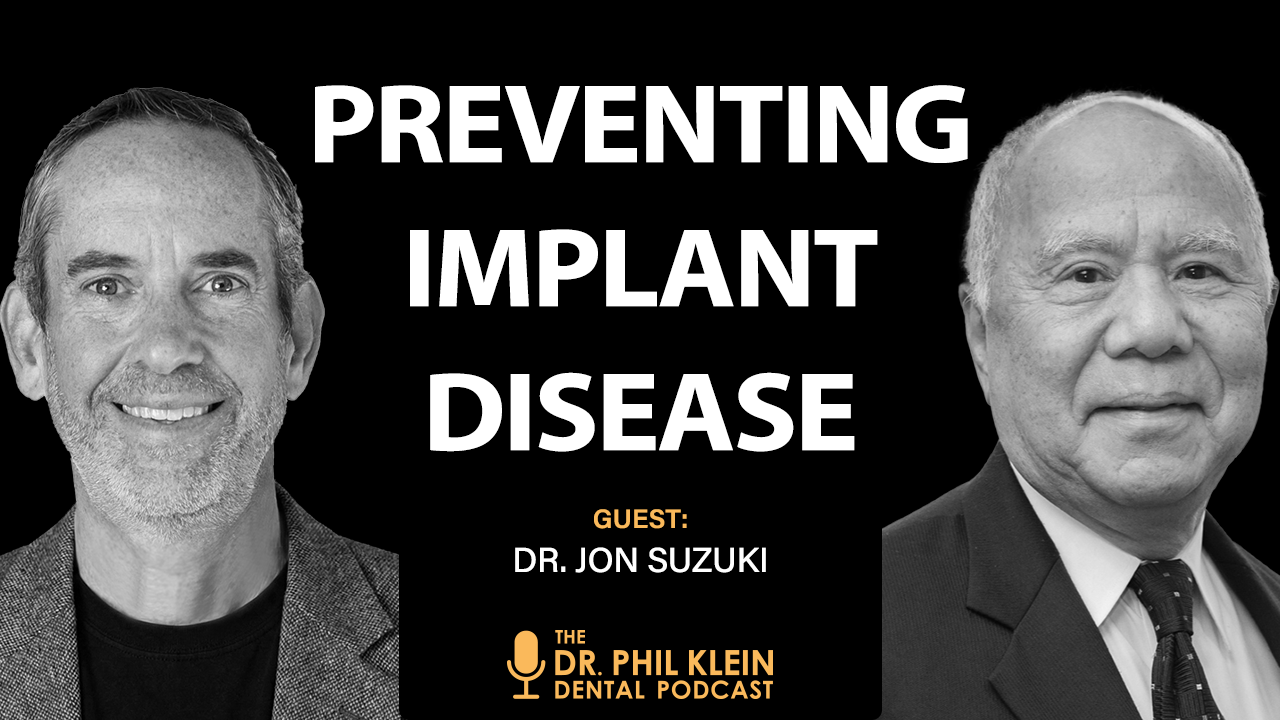


Episode 784: Implant Rescue: Non-Surgical and Surgical Treatment of Peri-implantitis
 |
When implant complications like peri-implantitis arise, do you reach for the same tools you'd use on natural teeth, or have you developed specific protocols for implant maintenance?
Dr. Jon Suzuki brings unparalleled expertise to this critical topic. With Presidential Appointments as Professor of Microbiology and Immunology and Professor of Periodontology and Oral Implantology at Temple University, he also serves as Chairman and Program Director of his department and Associate Dean for Graduate Education. Dr. Suzuki earned his D.D.S. from Loyola University of Chicago, Ph.D. in Microbiology from Illinois Institute of Technology, completed an NIH Fellowship in Immunology at University of Washington, received his Clinical Certificate in Periodontics from University of Maryland, and holds an MBA from the Katz Graduate School of Business. He previously served as Dean at University of Pittsburgh for a decade and was appointed Chairman of the FDA Dental Products Panel. Dr. Suzuki is a Diplomate of the American Board of Periodontology, Fellow of the American and International College of Dentists, and has published over 150 papers, chapters, and abstracts.
This episode provides a comprehensive approach to managing peri-implant complications, from early mucositis through advanced peri-implantitis. Dr. Suzuki explains why implant disease progression differs fundamentally from periodontal disease due to the absence of periodontal ligament and reduced vascularity. The discussion covers evidence-based protocols for both non-surgical and surgical interventions, with particular attention to when each approach is most appropriate and what outcomes clinicians can realistically expect.
Episode Highlights:
- Local drug delivery systems like minocycline can achieve 50% or higher success rates in early-stage peri-implantitis when combined with improved oral hygiene, though these medications are FDA-approved for teeth rather than implants. The key determining factor for success is patient home care compliance, with circumferential drug dispersion occurring within 10-14 days of injection into the deepest pocket.
- Stainless steel instruments create gouges and scratches on titanium implant surfaces that promote bacterial colonization and metal corrosion product release. Instead, clinicians should use resin scalers, titanium curettes, or ultrasonic tips with plastic sleeves, while waiting nine months post-placement before initial probing or scaling procedures.
- Chlorhexidine substantivity varies significantly between delivery methods, with minocycline and doxycycline local delivery providing 10-14 days of antimicrobial activity, while chlorhexidine chips offer only 8-12 hours. Patients should continue 0.12% chlorhexidine rinses twice daily for 2-3 weeks following debridement and local drug delivery.
- Surgical approaches include resective procedures that remove implant threads and recontour bone for cleanability, regenerative procedures using bone grafts and membranes in favorable defect morphology, and laser therapy using neodymium YAG at 1064 nanometers. The laser approach offers four mechanisms: pocket epithelium removal, antimicrobial action, anti-inflammatory effects through arachidonic acid pathway reduction, and biostimulation of wound healing cells.
- Implant regeneration differs fundamentally from periodontal regeneration due to the absence of periodontal ligament, reduced immune response, and lack of biological width with only epithelial attachment present. This makes implants more susceptible to occlusal trauma, requiring night guard protection, and creates higher risk for disease progression that's more difficult to reverse than natural tooth periodontitis.
Perfect for: periodontists, oral surgeons, general dentists placing or maintaining implants, dental hygienists working with implant patients, and residents learning peri-implant disease management protocols.
Discover evidence-based strategies that could transform your approach to implant maintenance and peri-implantitis treatment.
Disclaimer
Viva Learning LLC sites offer content that include opinions, techniques, recommendations, etc. from a variety of writers and speakers that are not necessarily endorsed by Viva Learning LLC, its associates and sponsored Viva Affiliates. Viewers are responsible for verifying the validity, accuracy and relevance of all content before implementing any techniques, products or recommendations into their clinical setting. Viewers understand that Viva Learning LLC, its associates, writers, speakers and sponsored Viva Affiliates are not in any way responsible or liable for any adverse events that may occur (i.e., in a clinical setting or anywhere) based on any information disseminated from Viva Learning LLC sites, including all Viva Learning sites.
The copyrights and other rights to the slides and video contained in a webinar posted on this website are owned by the speaker, Viva Learning LLC, and/or the sponsor company and/or its subsidiaries worldwide. Viewers are only authorized to view the content of the webinar (live and archive) at this Website and are not permitted to screen capture, record and/or download any content displayed in this webinar. You may not make any part of this Website available as part of another web site whether by hyperlink framing on the Internet or otherwise.
The copyrights and other rights to the audio contained in a Viva Podcast are owned by Viva Learning LLC. Viewers are authorized to listen to the content of the podcast and are permitted to download any podcast for personal use only. You may not, however, make any part of this Website available as part of another web site whether by hyperlink framing on the Internet or otherwise.
By signing up for a free webinar and/or podcast you give Viva Learning LLC and/or its Viva Learning Affiliates permission to send you emails alerting you to future CE opportunities and e-learning content.
California State Dental Board Provider Statement
Viva Learning is a registered continuing education provider in the state of CA. Dental Board of CA Provider #RP 5747. Approved through 6/30/2026
Questions regarding our Conditions of Usage, Privacy Policy, or other policy related material can be directed to our support staff by clicking on the "Support" link or you can email us at: support@vivalearning.com.
Approval does not imply acceptance by any regulatory authority or AGD endorsement.
Approval period: 11/1/2025 - 10/31/2029. AGD Provider # 217544
Presenter Information: Dr. Jon Suzuki
 |
Dr. Jon Suzuki has a Presidential Appointment as Professor of Microbiology and Immunology in the School of Medicine and Professor of Periodontology and Oral Implantology in the School of Dentistry at Temple University, Philadelphia, PA. USA. He also serves as Chairman and Program Director of the Department of Periodontology and Oral Implantology and Associate Dean for Graduate Education at Temple University. He has been Dean at the University of Pittsburgh for a decade, CEO of the University faculty practice plan, and Chief of Hospital Dentistry. Dr. Suzuki received his D.D.S. from Loyola University of Chicago and Ph.D. in Microbiology from the Illinois Institute of Technology. He completed an N.I.H. Fellowship in Immunology at the University of Washington in Seattle, and a Clinical Certificate in Periodontics at the University of Maryland. His MBA (emphasis on International Affairs) is from the Katz Graduate School of Business of the University of Pittsburgh. Dr. Suzuki has recently been appointed as Chairman of the Food and Drug Administration Dental Products Panel, Silver Spring, MD. With a term ending in October 31st, 2018. He is on the faculty of the US Navy National Naval Medical Command, Bethesda, MD, and also holds Professorships at Nova Southeastern University, Ft. Lauderdale, FL, the University of Maryland, and the University of Oklahoma. He served as Chairman of the American Dental Association Council on Scientific Affairs, Chicago, and continues to serve as a consultant to the Scientific Affairs Council, Practice Management Council, and Commission on Dental Accreditation. Dr. Suzuki served on the National Institutes of Health National Dental Advisory Research Council, and numerous NIH Study Sections, Bethesda, MD. Dr. Suzuki has current hospital appointments at the Episcopal Hospital, Philadelphia, PA and the Veterans’ Affairs Medical Centers. He is a fellow of the American and International College of Dentists, a Boarded Specialist Microbiologist and former Board Examiner of the American College of Microbiology, a Diplomate and current Board Examiner of the International Congress of Oral Implantology, and a Diplomate of the American Board of Periodontology. Dr. Suzuki is the current Executive Secretary/Treasurer of the Supreme Chapter of Omicron Kappa Upsilon, the national Honorary Dental Society, and has served in this position almost a quarter of a century. His honors include being named “Alumnus of the Year”, Loyola University of Chicago, “Alumnus of the Year”, Illinois Wesleyan University, “Recognized Alumnus in Biological Sciences”, Illinois Institute of Technology, and “Faculty of the Year”, University of Maryland. Dr. Suzuki won 1st place, Orban Prize Competition of the American Academy of Periodontology and won 1st place in the ADA/Dentsply SCADA Table Clinic Competition. He is in private practice limited to hospital periodontics in Philadelphia. Dr. Suzuki has published over 150 papers, chapters, and symposia, 200+ abstracts, and 1 textbook in Medical Technology. |
Viva Learning is an approved AGD PACE Provider and California State Dental Board Provider of dental continuing education. Viva Learning strives to deliver balanced, objective and clinically relevant information grounded on scientific research. Lecturers who are invited to deliver Viva CE webinars are advised to substantiate their claims with research-supported data and to disclose all commitments to, or relationships with, any commercial entity within the dental industry. In many cases, lecturers are sponsored by a dental manufacturing company, which provides them with support in the form of honorarium and/or dental products and equipment in order to help with clinical presentations. Prior to each live CE webinar, lecturers are made aware of the importance of delivering their presentations without commercial bias, and where appropriate, to mention a variety of different product choices that may be relevant to the subject matter of the lecture, for the educational benefit of the participant.
Transcript
teeth. Peri-implantitis is basically irreversible, loss of bone,
loss of attachment, and sometimes having aesthetic concerns, especially when these dental implants
having peri-implantitis are in the anterior region of the dentition, in the, quote,
the smile zone.
Welcome to the Phil Klein Dental Podcast. Implants have changed the game for patients and
clinicians, but when complications like peri-implantitis come up, things can get tricky.
The good news? There are more tools than ever to help us manage it, both non-surgically and
surgically. In this episode, we'll talk about everything from local drug delivery systems and at
-home rinses to the right and wrong tools for cleaning implant surfaces. And when non-surgical
approaches just aren't enough, we'll explore surgical options like resective and regenerative
procedures. Plus, why laser therapy, especially NDAG, may be one of the best effective treatments
we have. Our guest will answer the big clinical questions. When is it best to use local drug
delivery? How long should patients stay on chlorhexidine? What makes implant regeneration different
from periodontal regeneration? and why it matters. And why is laser therapy showing such promise in
peri-implant care? So if you're looking for real-world strategies you can bring back to your
practice, stick with us. This episode is packed with practical insights to help improve implant
success and patient outcomes. Our guest is Dr. Jon Suzuki. He's a professor of microbiology and
immunology and of periodontology and oral implantology at Temple University.
A former dean at the University of Pittsburgh, he has chaired the FDA Dental Products Panel, led
the ADA Council on Scientific Affairs, and served on numerous NIH committees.
A diplomat of the American Board of Periodontology, he has published over 200 papers and a
textbook, and continues to teach and educate dentists all around the world. Before we bring in our
guest, I do want to say that if you're enjoying these episodes and want to support the show, please
follow us on Apple Podcasts or Spotify. You'll be the first to know about our new releases and our
entire production team will really appreciate it. Dr. Suzuki, it's a pleasure to have you on the
show. Thank you very much for having me, Phil. So to begin this podcast, let's talk about the
progression of the disease process. that ends with peri-implantitis.
It actually ends with extraction of the implant, but we're not going to get into that in this
episode. So it begins with what in a natural tooth is gingivitis, but it's not called that with an
implant. It's called mucositis. So let's talk about the three different stages, the progression of
this disease, and that will set us up for what we're going to talk about further into the podcast
episode, which is non-surgical and surgical intervention in order to preclude this disease from...
getting to the point where the implant will fail and it would have to be removed? The implant
health, I believe, can be designated into three different stages in terms of clinical presentation
and overall prognosis. But the first stage is the stage of dental implants that we wish all our
patients would have, and that's a healthy, maintained dental implant. The second stage is the
earliest stage of disease, and that's referred to as peri-implant mucositis or peri-mucositis or
sometimes implant peri-mucositis. Those are all synonyms with what I refer to as peri-implant
mucositis. This is generally a soft tissue disease. It is readily reversible with improved oral
hygiene and hygiene care. The third stage of implant health is periimplantitis,
which is analogous to peritontitis in teeth. Periimplantitis is basically irreversible,
loss of bone, loss of attachment, and sometimes having aesthetic concerns,
especially when these dental implants having periimplantitis are in the anterior region of the
dentition, in the, quote, the smile zone. Those are basically the three different levels that I
consider the levels of implant health. Yeah, and we talked about on other episodes that we've done,
Dr. Suzuki, how because of the lack of PDL in the implant architecture,
the way it integrates with bone directly into the metal surface of the implant,
we don't have that natural protection that we normally get with the periodontal ligament.
And the soft tissue as well, because of the way, just the architecture of the way the implant is
situated with our natural bone. So we have to be particularly careful about the progression of
disease once we get out of stage one. And if it does go out of stage one into peri-implant
mucositis, we certainly want to catch it there early as possible and treat it so that it doesn't...
and progress into stage three, which is what you call peri-implantitis. And we all know that term,
which is obviously detrimental to the implant survival, which we can actually lose the case if it's
not treated. So let's talk about stage three for a minute. And we're talking about peri
-implantitis. When do you find it most effective to use as a non-surgical approach,
local drug delivery systems? And for my audience, What we're talking about here, local drug
delivery systems, is actually putting the antimicrobial agent directly at the scene or the site of
where the inflammatory response is. So how does that play a role and how does that fit into the
overall treatment plan for periimplantitis? Well, in my opinion, the earliest stages of
periimplantitis were, for example, there's one or two threads showing radiographically,
or perhaps the probing depths are five to six millimeters of soft tissue. I believe,
and once again, I want to emphasize in my opinion, local drug delivery systems may be beneficial in
helping reverse or treat the disease. I also wanted to indicate, though, this is not an FDA
-approved of this drug. They are primarily FDA approved for teeth in the dentition to treat
periodontitis. So I wanted to emphasize that point, but it has worked selectively in many,
many cases and other clinicians around the world have also successfully used it only in the
earliest stages of periimplantitis. Coupled together, of course, with proper antimicrobial mouth
rinses and improved oral hygiene. Yeah, so let's talk about the actual antimicrobial agent itself.
What are we talking about specifically? Is it like a doxycycline or a minocycle?
What are the drugs we're talking about and how are they placed at the site? We'll be right back
with our guest. But first, I want to tell you about VOCO's newest composite, Grandioso for You.
Top clinicians are calling it the most tooth-like universal composite ever made. Unlike
traditional composites that force you to choose between either an anterior aesthetic composite,
a stronger layering posterior composite, or a fast but aesthetic compromising bulk fill,
Grandioso 4U does it all, simplifying your workflow while delivering superior results in a single
material. It cures 4mm in just 10 seconds, looks stunning with 5 cluster shades covering all 16
Vita shades, and handles like a dream with 50% less resin. It's a 91% filled nano hybrid,
giving you tooth-like strength, ultra-low shrinkage, exceptional wear, and an amalgam-like high
radio opacity. So as they say, seeing is believing. So grab your free sample of Grandioso for you
today at voco.dental. There's different types of local antimicrobial drugs that are,
in fact, FDA-approved. Doxycycline is, of course, one of them. The chlorhexidines is another one.
Minocycline is a third one. And there's no clinical publication that I know of that compares head
-to-head each, any one of these three. I tend to use minocycline because it's the easiest to
clinically manage and deliver to a periodontal pocket. an implant pocket.
So once we identify the patient is in the stage of peri-implantitis, walk us through the clinical
steps, including using local drug delivery in order to do our best non-surgically to treat this
case. First of all, assuming that there are six... probings taken around that failing dental
implant and carefully recorded of course the first step is to very carefully debride the area as
much as possible using mechanical means and by mechanical means i mean either an ultrasonic or a
piezo or perhaps even a nylon bristle brush to halt to mechanically remove any plaque any calculus
that might be there then irrigate properly, and then as the final step before the patient goes home
is to insert, inject a local drug delivery system like minocycline,
very carefully selecting the deepest pocket of those six readings around the failing dental implant
and injecting that particular drug according to the manufacturer's directions into that deepest
area. And within the next 10 to 14 days, there is a circumferential dispersion of that local drug
delivery system around the entire dental implant and an X antimicrobial for up to about two weeks
of time. Let's say two weeks have passed. And during those two weeks, I'm sure they were given
instructions to be fairly stringent, right, with home care, especially in that area.
What's the prognosis look like in many of these cases, and what does it depend on? Does it depend
on the pocket depth when it's first being treated? Is it more dependent on patient compliance at
home, or is it the combination? How do we figure out a prognosis where we think we can get this
peri-implantitis on this tooth under control? So from my clinical experience on this,
among others that have used the local drug delivery system, DECD, the absolute
determining factor is going to be the patient's home care. They have to very carefully enter
proximate clean and, of course, possibly even using power brushes and other local irrigating
devices in and around that area. Just a theoretical question, Dr. Suzuki. If someone had stringent,
perfect, absolutely meticulous home care, being that's the main factor that is contributing towards
a better prognosis, and no antibiotics were delivered. Is there any indication in your mind that
the results would be the same without the antibiotics? It's my opinion that the local drug dealer
system would be a great enhancement to the clinical success. Any experience with molecular iodine?
Because I know that's becoming popular among periodontists for use in the pocket with
periodontitis. I was wondering if you use that with periimplantitis. No, I have limited experience
with molecular iodine, publications that support it, but I have not directly used it.
Okay. And what about the, there's a term called substantivity, which basically, as you know,
means how long something lasts effectively where it's being placed.
Like mouthwash is very low substantivity. So you can rinse with it. It's antimicrobial, but 20,
30 minutes later, bacterial buildup starts to come back very quickly. Do we get some You mentioned
two weeks on the local drug delivery system like minocycline. Can we get two weeks where it's
actually effectively keeping the microbes at bay? Yes,
two of these three local drug delivery systems, meaning minocycline, and doxycycline have up to 10
days to 14 days substantivity. The third product, which releases chlorhexidine, has a more limited
substantivity of about 8 to 12 hours. What's your recommendation regarding the continued rinse of
chlorhexidine? So I assume that they're rinsing during the period of substantivity of the actual
antibiotics, and then that will extend after that, I assume? Yes, I recommend chlorhexidine 0.12%
in the United States, 0.2% in the rest of the world, BID, according to manufacturer's directions.
And I urge the patient to use this for two to three weeks after the debridement and the delivery of
a local drug delivery system. So let's assume a clinician is listening to this podcast and they
already have a good idea of how to treat these. cases of peri-implantitis, and they do everything
as you suggest, including the local delivery of the antimicrobial drug, the sustained rinse of
chlorhexidine. When they come back for their three-month recall, assuming compliance is high at
home, what are we looking at as far as success rate? And I know it depends on how bad the peri
-implantitis is, but let's assume that it's early stage. What are we looking at as far as getting
this thing healthy again? The prediction of success for treating peri-implantitis,
I believe, is at least 50%, if not higher, predicated upon the patient's home oral care and home
oral hygiene, and also following directions and using the post-operative care mouth rinsing.
So to me, it is more the patient's responsibility at this point in time.
Before we continue, I've got to give a shout out to our sponsor, NSK. These folks are the real
deal. Their air and electric handpieces are not only top tier, they're the highest rated in the
industry, peer-reviewed by Dental Product Shopper. Their Timex Z99L electric handpiece actually
scored the first ever perfect rating. And the Timex Z990L is the most powerful handpiece on the
market. So do yourself a favor. Check out everything they offer at nskdental.com and take
advantage of their free trial by reaching out to your local NSK rep. I've heard this many times
from many dentists. Once you start using NSK handpieces, you'll never look back. So I think it's
really important that the dentist who's selling these cases to the patient... working on case
acceptance makes it very clear to the patient that even though these are not real teeth that we're
putting in, we still have things to be concerned about. In fact, periodontitis is more easily
treated in most cases than peri-implantitis. I know they're hard to compare because, you know,
a very severe case of periodontitis obviously has a less prognosis than a mild case of peri
-implantitis, but... The bottom line is once it gets to a stage where there is bleeding on probing,
separation, threads are visible, that's kind of more difficult to reverse and manage than
periodontitis, is it not? Yes, it is. And you've also explained it biologically,
Phil, with the lack of a periodontal ligament in dental implants, there is also a lack of
vascularity around the implant for nutrients, for oxygen.
There's also a lack of the immune response and other protective defense mechanisms around the
dental implant. So those all fall into play at making the implant higher risk and more difficult to
treat. The second factor is that the soft tissue adhesion to a dental implant is only the
epithelial attachment. There is no soft tissue attachment in dental implants like there is the
network of gingival connective tissue fibers with teeth. probably remember the term biological
width of teeth. Well, there is no biological width of epithelial connective tissue and PDL to
dental implants. So there's a vast anatomical and physiological difference between the two.
Yeah. And that's why dental hygienists are scared to death to probe these implants because they're
afraid they're going to tear right through the hole. Whatever soft tissue is there, they're going
to go right through it. What is your recommendation about probing? Is there some sort of gentle?
approach to getting those six readings that you talked about earlier? My general rule of thumb is
that after surgical placement, that the restorative dentist and the dental hygienist wait nine
months of time before you probe or before you scale that particular area.
I'm giving you a nine-month benchmark. based primarily on the University of Maryland Hanna studies
where they did block sections of bone grafts around teeth looking for regeneration but dental
implant osteointegration is really not on the same level but with the zone of safety that I like to
give my patients I generally recommend waiting nine months because that's when regeneration is
complete around teeth and that's when I We'll proceed with regeneration complete around dental
implants. So getting into the instruments themselves, typically we use stainless steel for our
scaling and root planing. Obviously, stainless steel is not the ideal material on implants,
I assume. And please clarify that. And what instrument materials do you recommend?
do not recommend stainless steel instruments at all around dental implants one of my graduate
students and i did a research project early on in 2012 looking at stainless steel and the impact on
dental implants and we determined the large gouges result from using stainless steel implants on
titanium necks. But secondly, also, in addition to that, they have a great impact of stainless
steel and other types of metal curettes and other types of ultrasonic and piezo devices.
So I would refrain from using any type of stainless steel on dental implants. I do recommend resin
scalers and I do recommend titanium scaler curettes around dental implants.
And these tips that you're saying on the piezo ultrasonics and on the magnetostrictive ultrasonics,
what is that material made out of those tips? Basically, they're stainless steel tips, but the
manufacturers have... designed an acrylic or a plastic sleeve to put over the stainless steel tips
as a safety mechanism. And that probably is very safe to use if you use these plastic sleeves over
the stainless steel tips. So the goal, of course, is not to scratch the surface of the implant,
which is titanium. And stainless steel will do that. And in those scratches, you get this
colonization of bacteria. And I assume that's a... culprit to periimplantitis.
Colonization and bacteria coupled together with what we now realize is the release of metal
corrosion products and metal shards from that particular series of devices.
Implant regeneration, the whole concept of implant regeneration is modeled after periodontal
regeneration. And you could understand why, because that's what we've studied for decades and
decades. But as we mentioned, several times in this podcast and others that we've done that
implants do not have a ligament like natural teeth do. They don't have a PDL.
So how does this difference change your approach to regenerative procedures around implants?
Because the implants do not have a PDL, in my opinion,
they're much more susceptible to occlusal disharmonies, including prematurities during different
excursive movements, and especially for bruxism and parafunctional habits. So I highly recommend a
retainer or a night guard for all implant patients because that implant does not have the give or
the, quote, the forgiveness that a PD-L around a tooth might give the dentition. So let me ask you
this. When we're in the stage of peri-implantitis and we went non-surgical in the beginning,
which we always want to be conservative, and we did all the stuff that you recommended. We used
targeted therapy with antimicrobial agents like doxycycline or minocycline delivered right at the
site. We had them on chlorhexidine rinses for two weeks, stringent home care protocol,
good home care education and everything else. And it's not hitting the mark. And we're starting to
see the threads of the implant more apical than we would like. And it's not progressing in the
right direction. It's actually going in the wrong direction. So when do you make that decision
where we have to go surgery? And what does the periodontist actually plan to do in most of these
cases as a surgical procedure to save this implant? If you're looking for speed,
beauty, and strength in a zirconia block, check out Katana One Speed. It is a game changer in CAD
CAM dentistry. To learn more, visit curaridental.com. Well, there's three approaches that...
uh a periodontist a specialist or restorative dentist can use when the particular peri-implantitis
stage is triggered from mild stage to more moderate stage and i'm defining that moderate peri
-implantitis as two to five threads of exposure into the oral cavity or scene radiographically so
between two and five threads showing or up to 50 percent of bone loss around a dental implant then
there's three different avenues of approach that I believe a clinician can use to manage the
periimplantitis. One of them is a resective approach, which is apically positioning the flaps,
removing the threads of an implant, and making the implant surface smooth so that the patient can
at least keep it clean and free of plaque. The second approach is a regenerative approach and using
the decades of research about tooth regeneration, bone grafts coupled together with membranes and
other types of biologics can also rebuild that lost attachment apparatus of the dental implant.
The third approach, which is relatively a novel approach, new approach, are the use of dental
lasers. More recently, I've been using the neodymium YAG laser at 1064 nanometers to treat many
cases of periimplantitis as well. So those are the three approaches that clinicians can use.
Are any of these surgical approaches performed concurrently? The answer is no. Once a decision,
once a clinical decision has been made as to how to best approach the management of this
periimplantitis, you pretty much have laid out the treatment plan. A resector procedure,
for example, when you're removing threads and bone, that's totally irreversible and cannot be
reversed in any way. And patients just have to live with it and try to keep that area clean in the
long term. of that particular dental implants that's been treated with the resective approach is
highly questionable in my opinion. With the resective approach, the ratio is not favorable as it
was obviously when the implant was put in and it was fully integrated because you're smoothing out
the coronal portion of that implant so that it's more cleansable, I assume, right? Because it's no
longer, that thread is no longer benefiting the patient because there's no integration there
anymore. Yes, you're dramatically changing the crown root ratio, which restorative dentists and
prosthodontists know very, very well. And secondly, you're causing a large impaction area for food.
As some of my patients claim, they get a second helping of food, even when they go home from a
restaurant. And then the third approach, it could be very unaesthetic, especially if it's in the
smile zone. So what is the determining factor that influences the periodontist to either go
resective or regenerative in their approach to the surgery of that implant? Well,
it's a clinical... decision at that time but in my opinion the regenerative approaches are favored
by the topography of the osseous defect so what we know in bone grafting and probably an extraction
socket is the best example of it phil that when there's four walls or five walls around an osseous
defect it serves as a very very nice collection point for a bone graft material to be placed into
it and to result in regeneration. When there's less walls available, like one wall or two walls,
or even no walls at all, then a regenerative approach will not work as predictably.
And so therefore you may favor another approach. Now you mentioned Dr. Suzuki lasers as one of the
surgical approaches to handling peri-implantitis.
ND YAG laser, I think 1064 nanometers, what you mentioned. Tell us about that. Yes.
And it's the one that I am a certified instructor of currently. But the neodymium YAG laser at 1064
nanometers, in my view, actually has more predictable results than either of the first two.
If that particular laser approach is moderate or does not work completely to your satisfaction,
the clinician still can use one of those other two modalities. But when you choose the other two
modalities, generally speaking, you don't go and use the laser. So to me, the laser approach is
relatively conservative based upon the first two. So tell us what you're actually doing with the
laser. And is there a need to flap the tissue? It's no flap at all. It's a procedure called LAPIP,
Laser Assisted Periimplantitis Protocol, virtually a non-surgical approach coupled together with
the two different settings of the laser with a piezo debridement in between, entirely non
-surgical approach for in my opinion, pretty good favorable regeneration around a failing dental
implant. What is that laser doing besides decontaminating? Is it encouraging bone growth?
As I published in 2017 in the compendium, this laser has the capability of four different
approaches. First of all, of removing the pocket lining of epithelium, which is frequently laced
with contaminating bacterial and chronic inflamed tissue. The second is basically an antimicrobial
approach, killing especially. the most putative periodontal pathogens,
such as the black pigmented bacteroides. And then third, a very, very strong anti-inflammatory
component. It releases and reduces the arachidonic acid pathway. And there is much less
prostaglandin being produced and therefore translating to less pain,
less discomfort for the patient, less inflammation for the patient. And fourth is biostimulation.
The laser stimulates. The wound healing cells, the laser stimulates the immune response.
So therefore, the outcome is more accelerated in terms of a normal wound healing response.
So on principle, when we're treating patients with periodontal disease that can't be handled at the
GP level, the general practitioner level, they send it out to a periodontist and they do what they
can to make the pockets manageable by the patient. so they could be cleansable,
right? I mean, if the pockets are too deep, you could scale and root plan all day long at the
general dentist. The patient can't maintain eight millimeters, so something has to be done about
it, so they send it to a periodontist. And correct me if I'm wrong anyway, I'm an endodontist, so
I'm talking from a different perspective. But when you're talking about this laser here, and let's
say that that particular implant has a deep pocket around it, what is that laser doing to reduce
pocket depth to make it more cleansable? The laser is, first of all, removing the pocket lining of
epithelium in that pocket. Secondly, the laser is killing bacteria.
The third is that once there's bleeding in and around that site of wound healing,
the laser by a process called hemostasis, traps that particular osteogenic molecules in the site,
which is similar to a PRP or PRF. And the fourth is stimulating the wound healing cells and the
bone and fibroblast healing cells inside of that pocket. So those are the different steps of what
the laser is potentially capable of doing inside of that healing pocket.
With the research showing all this, Dr. Suzuki, it would seem to me that every periodontist should
be exploring this technique using the laser so that it can accomplish these physiologic changes to
the inflamed area. It's a clinical choice, and it's the choice that I've already made clinically
and the one that I teach, Phil. Right, so it's just a matter, you can't change everybody,
right? Even though it could be proven to be the best solution ever, clinicians tend to go with the
way they want to go. Let's hope more of these doctors out there, these specialists, and I guess
general dentists can also use a laser. I'm sure there are many out there that may be rural dentists
that don't have periodontists that they could send to that's close by. They should have a laser in
their office and do these treatments themselves, right? Absolutely. Actually, in the boot camps
that I've given in Saritas, California, probably at least 50% of my docs that have registered for
the course are periodontists, but the other 50% are restorative dentists.
So it's probably a pretty even mix at this point in time. And of course, we do have a collection of
oral and maxillofacial surgeons taking it because oral and maxillofacial surgeons are also faced
with failing dental. implants yeah absolutely absolutely again thank you very much Dr. Suzuki have a
great evening and uh we look forward to having you on future programs thank you phil for having me
again
 Episode 796. Why Dental Implant Disease Moves Faster—and What You Can Do About It
8/20/2026 - CE Credits: 0.5 CEU (Take Exam)
Episode 794. Health-Centered Dentistry: A Smarter Path to Improved Clinical Outcomes and Practice Growth
8/12/2026 - CE Credits: 0.25 CEU (Take Exam)
Episode 792. Out of Survival Mode: Building the Practice You Love
8/6/2026 - CE Credits: 0.5 CEU (Take Exam)
Episode 790. How a 31-Year-Old Dentist Built Trust, Case Acceptance, and a Fee-for-Service Cosmetic Practice
7/30/2026 - CE Credits: 0.5 CEU (Take Exam)
Episode 788. Making the Laser Leap: Implant Care That Pays Off
7/23/2026 - CE Credits: 0.5 CEU (Take Exam)
Episode 786. When Dental Patients Use HIPAA for Leverage and Retaliation
7/16/2026 - CE Credits: 0.5 CEU (Take Exam)
Episode 784. Implant Rescue: Non-Surgical and Surgical Treatment of Peri-implantitis
7/9/2026 - CE Credits: 0.5 CEU (Take Exam)
Episode 782. Pairing Perfect Impressions With The Exceptional Patient Experience
7/2/2026 - CE Credits: 0.5 CEU (Take Exam)
Episode 780. Know When to Let Go: Hiring Your Next Office Manager
6/25/2026 - CE Credits: 0.5 CEU (Take Exam)
Episode 778. Do Dentists Really Need to Advertise? A Practical Look at ROI
6/18/2026 - CE Credits: 0.5 CEU (Take Exam)
Episode 776. Attract, Convert, Deliver, Collect: NYC Prosthodontist Dr. Giglio Shares His Secret Sauce
6/11/2026 - CE Credits: 0.5 CEU (Take Exam)
Episode 771. Posture, Pain, and Prevention: The Ergonomics Wake-Up Call for Dental Professionals
5/21/2026 - CE Credits: 0.5 CEU (Take Exam)
Episode 769. Prescribing Nutrition: A Game Changer for Immediate Denture Outcomes
5/14/2026 - CE Credits: 0.5 CEU (Take Exam)
Episode 767. From Overwhelmed to Empowered: Taking Control of Your Dental Practice and Career
5/7/2026 - CE Credits: 0.5 CEU (Take Exam)
Episode 765. How a NYC Prosthodontist Built a High-Trust, High-Value Practice
4/30/2026 - CE Credits: 0.5 CEU (Take Exam)
Episode 763. From Burnout to Balance: Reclaiming Your Energy and Purpose in Dentistry
4/23/2026 - CE Credits: 0.5 CEU (Take Exam)
Episode 761. From Online Visitor to Booked Appointment: Dental Website Strategies That Work
4/16/2026 - CE Credits: 0.5 CEU (Take Exam)
Episode 759. From Diagnosis to Growth: A GP’s Success Story with CBCT
4/9/2026 - CE Credits: 0.5 CEU (Take Exam)
Episode 757. Antibiotic Resistance: Smarter Prescribing in Dental Care
4/2/2026 - CE Credits: 0.5 CEU (Take Exam)
Episode 755. Concerned Team Member Triggers OSHA Nitrous Oxide Inspection
3/26/2026 - CE Credits: 0.5 CEU (Take Exam)
Episode 753. The Rise of DIY Dentistry on Social Media: Why it Matters
3/19/2026 - CE Credits: 0.5 CEU (Take Exam)
Episode 751. Bridging the Dentist-Hygienist Gap: Comprehensive Care Starts in the Hygiene Chair
3/12/2026 - CE Credits: 0.5 CEU (Take Exam)
Episode 749. Why Every GP and Hygienist Should Be Using a Dental Laser
3/5/2026 - CE Credits: 0.5 CEU (Take Exam)
Episode 747. Breaking Free: Escaping Corporate Dentistry and Creating a Practice You Love
2/26/2026 - CE Credits: 0.5 CEU (Take Exam)
Episode 745. Clear Aligner Therapy: Treating Adult Lower Anterior Crowding the Right Way
2/19/2026 - CE Credits: 0.5 CEU (Take Exam)
Episode 743. How a Dentist Transformed Her Career with an AI-Driven, Remote-Staffed Practice
2/12/2026 - CE Credits: 0.5 CEU (Take Exam)
Episode 741. What Can Doom Your Implants? Uncovering the Risks of Implant Failure
2/5/2026 - CE Credits: 0.5 CEU (Take Exam)
Episode 739. Seal the Deal: Perfecting Rubber Dam Placement in Endodontics
1/29/2026 - CE Credits: 0.5 CEU (Take Exam)
Episode 738. Retain Your Dental Team by Fostering a Culture of Health and Wellness
1/26/2026 - CE Credits: 0.5 CEU (Take Exam)
Episode 737. The Blue Light Hazard in Dentistry: What You Need to Know
1/22/2026 - CE Credits: 0.5 CEU (Take Exam)
Episode 735. Treating the Avulsed Permanent Incisor with Partially Formed Root
1/15/2026 - CE Credits: 0.25 CEU (Take Exam)
Episode 732. Sterilization Breakdown: A Dentist's Shocking Discovery and its Aftermath
1/5/2026 - CE Credits: 0.25 CEU (Take Exam)
Episode 729. When the Attorney General Comes Knocking: IC Violations and Your Dental Practice
12/18/2025 - CE Credits: 0.25 CEU (Take Exam)
Episode 727. How Dental Partnership Groups Reshape Dental Practice Ownership
12/11/2025 - CE Credits: 0.25 CEU (Take Exam)
Episode 725. Start Before You’re Ready: Dr. Cohn’s Bold Path in Pediatric Dentistry
12/4/2025 - CE Credits: 0.5 CEU (Take Exam)
Episode 722. Proper Prevention and Response to an Eye Incident in Your Operatory
11/20/2025 - CE Credits: 0.5 CEU (Take Exam)
Episode 718. Medical Reimbursement for Dentists: What You Need to Know
11/6/2025 - CE Credits: 0.5 CEU (Take Exam)
Episode 716. Muscle Strengthening: A Better ROI than Disability Insurance
10/31/2025 - CE Credits: 0.5 CEU (Take Exam)
Episode 714. Airway & TMJ: The Competitive Edge for Your Practice and Career
10/23/2025 - CE Credits: 0.5 CEU (Take Exam)
Episode 712. When Patients or Employees File Complaints: What Dentists Need to Know
10/16/2025 - CE Credits: 0.5 CEU (Take Exam)
Episode 710. The Tech-Savvy Hygienist: Navigating AI and Innovation
10/9/2025 - CE Credits: 0.25 CEU (Take Exam)
Episode 708. In-House Milling & 3D Printing: Making the Right Call for Your Practice
10/2/2025 - CE Credits: 0.5 CEU (Take Exam)
Episode 706. Thriving, Not Surviving: How Dentists Can Stay Passionate and Avoid Burnout
9/25/2025 - CE Credits: 0.5 CEU (Take Exam)
Episode 704. Infection Control and Employee Whistleblowing
9/18/2025 - CE Credits: 0.5 CEU (Take Exam)
Episode 703. The Right Fit: Delivery Systems and Ergonomics in Dentistry
9/15/2025 - CE Credits: 0.25 CEU (Take Exam)
Episode 700. Finding and Retaining Your Ideal Dental Office Manager
9/4/2025 - CE Credits: 0.5 CEU (Take Exam)
Episode 698. Navigating Oral Ulcerative Conditions: When to Treat, Refer, or Reassure
8/28/2025 - CE Credits: 0.25 CEU (Take Exam)
Episode 696. The Truth About Mouthwashes, Molecular Iodine & More: Insights from a Periodontist
8/21/2025 - CE Credits: 0.25 CEU (Take Exam)
Episode 694. The Rise of Fractional Dental Executives: A Conversation with Melissa Turner, RDH
8/14/2025 - CE Credits: 0.25 CEU (Take Exam)
Episode 692. Code & Collect: Unveiling the Secrets of Medical Billing Benefits
8/7/2025 - CE Credits: 0.25 CEU (Take Exam)
Episode 690. Beyond the Chair: Why Teledentistry is So Important to Your Practice
7/31/2025 - CE Credits: 0.25 CEU (Take Exam)
Episode 688. From Files to Photons: How Lasers Improve Cleaning & Success Rates
7/24/2025 - CE Credits: 0.25 CEU (Take Exam)
Episode 686. Patient Owes You Money and Wants Their Dental Records: HIPAA Rules!
7/17/2025 - CE Credits: 0.25 CEU (Take Exam)
Episode 684. Dental Career Longevity: A Little Fitness Each Day Goes a Very Long Way
7/10/2025 - CE Credits: 0.5 CEU (Take Exam)
Episode 682. Airway Sleep Dentistry in the Pediatric Population
7/3/2025 - CE Credits: 0.25 CEU (Take Exam)
Episode 680. The Nuts and Bolts of Root Resorption and How to Treat It
6/26/2025 - CE Credits: 0.5 CEU (Take Exam)
Episode 678. Teledentistry: Integrating Virtual Care into Your Practice
6/19/2025 - CE Credits: 0.5 CEU (Take Exam)
Episode 676. The Hidden Dangers of Leukoplakia: What Every Dentist Should Know
6/12/2025 - CE Credits: 0.25 CEU (Take Exam)
Episode 674. Forging Frontiers: Seizing Dental Opportunities in a New Locale
6/5/2025 - CE Credits: 0.25 CEU (Take Exam)
Episode 672. Profitable Care: Financial Benefits of Medical Management of Caries
5/29/2025 - CE Credits: 0.5 CEU (Take Exam)
Episode 670. Dental Hygiene: Top 5 Things No One Told Me in School
5/22/2025 - CE Credits: 0.5 CEU (Take Exam)
Episode 669. Reaching the Unreachable: Killing Microbes in Lateral and Accessory Canals
5/19/2025 - CE Credits: 0.5 CEU (Take Exam)
Episode 668. Ergonomic Excellence: Positioning Strategies for Dentists and Patients
5/15/2025 - CE Credits: 0.25 CEU (Take Exam)
Episode 666. Protect Against Peri-Implantitis: Kill the Bugs in the Implant Channel
5/8/2025 - CE Credits: 0.25 CEU (Take Exam)
Episode 664. Treating the Avulsed Permanent Central with Fully Formed Root
5/1/2025 - CE Credits: 0.25 CEU (Take Exam)
Episode 662. The Worn-Down Currette: Retip, Sharpen, or Replace?
4/25/2025 - CE Credits: 0.25 CEU (Take Exam)
Episode 660. Medical Management of Caries: Demystifying the Use of SDF and Glass Ionomer
4/17/2025 - CE Credits: 0.25 CEU (Take Exam)
Episode 658. Full Coverage Crowns on Primary Teeth: Pros, Cons, and Best Practices
4/10/2025 - CE Credits: 0.5 CEU (Take Exam)
Episode 656. Preparing Ourselves For an Injury-free Career in Dentistry
4/3/2025 - CE Credits: 0.25 CEU (Take Exam)
Episode 654. Why Clinical Technique Is Key to Intraoral Scanner Accuracy
3/27/2025 - CE Credits: 0.5 CEU (Take Exam)
Episode 652. From Complaints to Compliance: Mastering OSHA Inspections
3/20/2025 - CE Credits: 0.5 CEU (Take Exam)
Episode 650. Simple Ways to Redefine Your Dental Practice Through Superior Service
3/13/2025 - CE Credits: 0.25 CEU (Take Exam)
Episode 646. From Kansas City to Wichita: A Dentist’s Journey to Fulfillment
3/1/2025 - CE Credits: 0.25 CEU (Take Exam)
Episode 645. Employee Impact on Dental Practice Success
2/26/2025 - CE Credits: 0.25 CEU (Take Exam)
Episode 644. Are You Sure Your Instruments Are Ready for Sterilization?
2/24/2025 - CE Credits: 0.5 CEU (Take Exam)
Episode 643. Infection Control and Prevention: The Devil is in the Details; A Discussion with Emily Boge
2/19/2025 - CE Credits: 0.5 CEU (Take Exam)
Episode 641. Where Are the Hygienists? Tackling the Dental Staffing Deficit
2/12/2025 - CE Credits: 0.25 CEU (Take Exam)
Episode 639. The Initial Scan Visit: Building Strong Patient Relationships Digitally
2/5/2025 - CE Credits: 0.5 CEU (Take Exam)
Episode 637. Common Oral Pathologies: Best Practices for Dental Professionals
1/30/2025 - CE Credits: 0.5 CEU (Take Exam)
Episode 635. Building a Winning Dental Team Without Being a Natural Leader
1/22/2025 - CE Credits: 0.25 CEU (Take Exam)
Episode 633. Brace for Impact: Buying a Practice that's not OSHA Compliant
1/15/2025 - CE Credits: 0.5 CEU (Take Exam)
Episode 629. Printed Efficiency: Revolutionizing Your Practice with a 3D Printer
1/2/2025 - CE Credits: 0.25 CEU (Take Exam)
Episode 628. High-Frequency Healing: Revolutionizing Endodontic Disinfection
12/30/2024 - CE Credits: 0.5 CEU (Take Exam)
Episode 627. Endodontic Irrigation: Power-flushing Your Way to Success
12/24/2024 - CE Credits: 0.25 CEU (Take Exam)
Episode 624. Oral HPV Testing: A New Dental Approach to an Old Problem
12/9/2024 - CE Credits: 0.25 CEU (Take Exam)
Episode 623. Emergency Action Planning for Violent Incidents in Dental Facilities
12/4/2024 - CE Credits: 0.25 CEU (Take Exam)
Episode 621. 3D Facial Scanners, 3D Printers, AI and How to Transition Into a Digital Practice
11/27/2024 - CE Credits: 0.25 CEU (Take Exam)
Episode 616. Stop Giving CT's Away and Bill to Medical Insurance!
11/11/2024 - CE Credits: 0.25 CEU (Take Exam)
Episode 615. Women in Dentistry: From Practice to Podium
11/6/2024 - CE Credits: 0.25 CEU (Take Exam)
Episode 613. Beyond the Smile: Embracing an Overall Wellness Approach to Dentistry
10/31/2024 - CE Credits: 0.25 CEU (Take Exam)
Episode 611. A Periodontist Shares His Secret Sauce For Successful Perio Outcomes
10/24/2024 - CE Credits: 0.25 CEU (Take Exam)
Episode 608. Making the Jump from Insurance-based to Fee-for-Service
10/9/2024 - CE Credits: 0.25 CEU (Take Exam)
Episode 606. Beyond City Limits: Dentistry in Rural America
10/2/2024 - CE Credits: 0.5 CEU (Take Exam)
Episode 604. Increasing Violence in the Dental Workplace – What Would You Do?
9/25/2024 - CE Credits: 0.25 CEU (Take Exam)
Episode 602. Intra-oral Scanners: Rely on Your Team, Get Perfect Impressions and Reduce Your Chair Time
9/18/2024 - CE Credits: 0.25 CEU (Take Exam)
Episode 601. Attract, Convert and Deliver: Reliable and Efficient Systems in Your Practice
9/16/2024 - CE Credits: 0.25 CEU (Take Exam)
Episode 600. Why The Traditional Financial Advisor Is Failing You
9/11/2024 - CE Credits: 0.25 CEU (Take Exam)
Episode 598. Overcoming the Most Common Pain Points of Bonding
9/6/2024 - CE Credits: 0.5 CEU (Take Exam)
Episode 594. Taking a Seat at the Table: Women's Role in Leadership in Dentistry
8/21/2024 - CE Credits: 0.5 CEU (Take Exam)
Episode 592. How Your Practice Can Deliver a World-class Customer Experience
8/15/2024 - CE Credits: 0.25 CEU (Take Exam)
Episode 590. Sedation in Dentistry: How Far Should We Go and How Much Training Do We Need?
8/12/2024 - CE Credits: 0.25 CEU (Take Exam)
Episode 589. What Does OSHA Say About Workplace Violence?
8/7/2024 - CE Credits: 0.25 CEU (Take Exam)
Episode 587. How Motivational Interviewing Transformed My Clinical Practice
8/1/2024 - CE Credits: 0.25 CEU (Take Exam)
Episode 581. The Road to Practice Ownership: Financing Your Dental Dream
7/10/2024 - CE Credits: 0.25 CEU (Take Exam)
Episode 579. The Dental Entrepreneur: Balancing Risk and Reward
7/3/2024 - CE Credits: 0.25 CEU (Take Exam)
Episode 577. Your Private Practice Is NOT A Job: Why You Should Treat It as a Long-Term Business Investment
6/26/2024 - CE Credits: 0.25 CEU (Take Exam)
Episode 575. Path to the Apex: Minimally Invasive or Straight Line Access?
6/19/2024 - CE Credits: 0.25 CEU (Take Exam)
Episode 573. OSHA Inspection Gone Bad: Don't Let This Happen to You!
6/14/2024 - CE Credits: 0.25 CEU (Take Exam)
Episode 571. Finding The Right Exit Strategy: Striking A Personal Balance Between Financial & Emotional Readiness
6/10/2024 - CE Credits: 0.25 CEU (Take Exam)
Episode 570. Buying & Selling a Practice: Building Trust Along the Way
6/5/2024 - CE Credits: 0.25 CEU (Take Exam)
Episode 568. Basic Surgical Implant Placement for the GP
5/30/2024 - CE Credits: 0.5 CEU (Take Exam)
Episode 566. Periodontist Talks about Implants, Lasers and Treatment Planning with the Oral-Systemic Link in Mind
5/22/2024 - CE Credits: 0.25 CEU (Take Exam)
Episode 564. Opening the VDO is Simple and Fast: Gives You Prosthetic Convenience and is Good For Your Patients!
5/15/2024 - CE Credits: 0.25 CEU (Take Exam)
Episode 562. The Infection Control Coordinator's Impact on Dental Practices
5/8/2024 - CE Credits: 0.25 CEU (Take Exam)
Episode 558. Unleashing the Team’s Impact on Practice Success
4/25/2024 - CE Credits: 0.25 CEU (Take Exam)
Episode 554. Oral Cancer and Head and Neck Evaluations: The Role of the Dental Practice and Getting Paid Through Medical Insurance
4/10/2024 - CE Credits: 0.25 CEU (Take Exam)
Episode 552. In-Office Milling: How to Transition to Single-Visit Dentistry
4/5/2024 - CE Credits: 0.25 CEU (Take Exam)
Episode 548. Implant Assessment: Fear Not, Your Guide Is Here!
3/21/2024 - CE Credits: 0.25 CEU (Take Exam)
Episode 546. Navigating Responsible Cosmetic Dentistry for the Younger Generation
3/14/2024 - CE Credits: 0.25 CEU (Take Exam)
Episode 545. DSO, DPO, and DPG: Demystifying Corporate Dentistry Options
3/11/2024 - CE Credits: 0.25 CEU (Take Exam)
Episode 544. Attract, Convert and Deliver: Patient Communication
3/7/2024 - CE Credits: 0.25 CEU (Take Exam)
Episode 542. Navigating Dental Lasers: From Clinical Impact to Practice Integration
2/28/2024 - CE Credits: 0.5 CEU (Take Exam)
Episode 541. Establish Your Niche and Practice with Passion: Attract the Patients You Want to Treat
2/26/2024 - CE Credits: 0.25 CEU (Take Exam)
Episode 539. Busting the Myth that More Production Guarantees Success
2/19/2024 - CE Credits: 0.25 CEU (Take Exam)
Episode 538. Where to Begin: The Technology You Need to Begin Your Digital Journey
2/14/2024 - CE Credits: 0.25 CEU (Take Exam)
Episode 536. How to Keep it Together, Stay Happy and Have a Long Fulfilling Career: A Dentist's Perspective
2/8/2024 - CE Credits: 0.25 CEU (Take Exam)
Episode 534. The “Health-centered” Secret to Loving Your Practice
2/1/2024 - CE Credits: 0.25 CEU (Take Exam)
Episode 533. Safeguarding Against the Rise in Throat Cancer
1/31/2024 - CE Credits: 0.25 CEU (Take Exam)
Episode 528. Finding True North: How to Set and Stay the Course with Digital Dentistry
1/17/2024 - CE Credits: 0.25 CEU (Take Exam)
Episode 526. Cutting through the Gordian Knot: Where and How to Start your Digital Dentistry Adventure
1/10/2024 - CE Credits: 0.25 CEU (Take Exam)
Episode 524. Burn the Ships: Why I Embraced Digital Dentistry and Never Looked Back
1/3/2024 - CE Credits: 0.25 CEU (Take Exam)
Episode 506. Attract, Convert and Deliver Part 1: Marketing Your Practice
10/9/2023 - CE Credits: 0.25 CEU (Take Exam)
Episode 492. Photobiomodulation and What it Can Do for Dentistry
8/10/2023 - CE Credits: 0.25 CEU (Take Exam)
Episode 491. Infection Control Protocol and the Disgruntled Employee
8/7/2023 - CE Credits: 0.25 CEU (Take Exam)
Episode 487. Victory with Verbal Skills: Hygienist to Patient
7/19/2023 - CE Credits: 0.25 CEU (Take Exam)
Episode 480. It's Time to Make a Career Change: Pursuing My Passion To Become a Dentist
6/7/2023 - CE Credits: 0.25 CEU (Take Exam)
Episode 443. Hand Hygiene Recommendations from ICP Expert, Dr. Marie Fluent
1/11/2023 - CE Credits: 0.25 CEU (Take Exam)
Episode 427. Infection Prevention Starts with Clean Hands
11/15/2022 - CE Credits: 0.25 CEU (Take Exam)
Episode 367. Common Sense Cleaning, Disinfecting, and Sanitizing: Are You Doing Things Right in Your Practice?
2/7/2022 - CE Credits: 0.5 CEU (Take Exam)