





| Dental Podcast Episode - The Dr. Phil Klein Dental Podcast | Listen on: |

|

|

|

|
and others. |
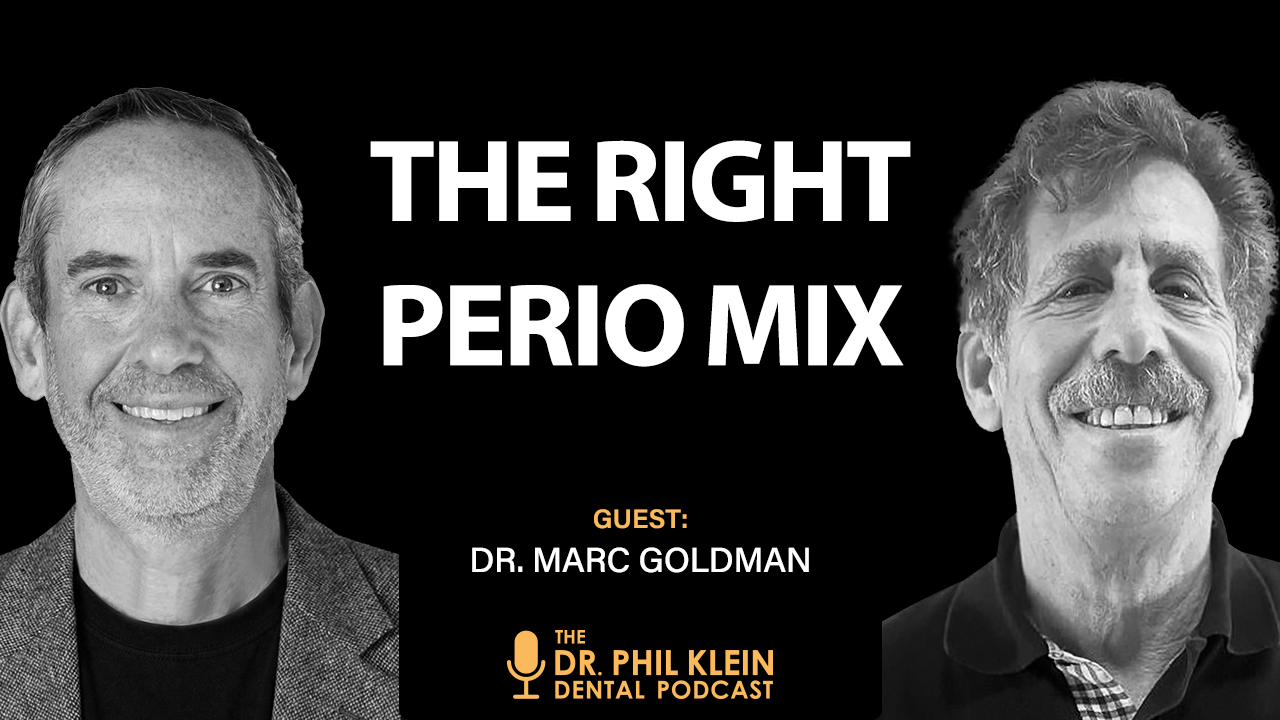
Episode 814: The Right Perio Mix for the GP
 |
Are you confident that your hygiene department is truly diagnosing and treating periodontal disease at the level your patients deserve — or are you leaving significant clinical and financial opportunity untreated?
Dr. Marc Goldman is a board-certified periodontist with over 40 years of clinical experience, founder of a premier periodontal practice in Millburn, New Jersey, and an educator at a general practice residency program at Beth Israel Hospital in Newark. With decades of mentoring general dentists and residents on the realities of periodontal and implant therapy, Dr. Goldman brings both the clinical depth and the practice management perspective that few specialists can offer.
This episode examines one of the most underappreciated revenue and risk management opportunities in general dentistry: periodontal therapy. Dr. Goldman and Dr. Phil Klein break down which periodontal services GPs should confidently keep in-house, which cases warrant referral, and how the GP-periodontist relationship should function as a collaborative business partnership rather than a competitive one. The conversation covers crown lengthening, implant treatment planning, hygiene department efficiency, and the real-world consequences of underdiagnosing periodontal disease — including malpractice exposure.
Episode Highlights:
- Scaling and root planing is consistently underutilized in general practices where hygienists perform prophylaxis on patients who clinically require debridement at a therapeutic level. Using local anesthesia to anesthetize one or two quadrants at a time dramatically improves patient comfort, clinician efficiency, and case throughput, with per-quadrant fees substantially exceeding standard prophylaxis reimbursement.
- The full-mouth debridement code is frequently misused as a preliminary step before diagnosis, but this approach wastes a clinical visit, reduces reimbursement, and displaces the opportunity to initiate scaling and root planing immediately. If periodontal disease is present and the patient requires root planing and scaling, initiating treatment by quadrant during that same appointment is both more efficient and more appropriate.
- Crown lengthening is a significantly underutilized procedure in general practice, partly due to misconceptions about post-operative healing timelines. In many cases, adequate gingival healing occurs within two to three weeks, allowing the referring dentist to take a final impression or adjust a provisional restoration shortly thereafter — making the workflow disruption far less significant than commonly perceived.
- Implant treatment planning requires a systematic, multi-specialty approach before any surgical intervention is initiated. Key pre-implant considerations include periodontal health, attached tissue adequacy, bone volume and proximity to anatomical structures such as the sinus, adjacent tooth vitality, and whether orthodontic tooth movement is indicated to optimize implant site dimensions.
- Underdiagnosing or under-presenting periodontal disease carries both malpractice risk and significant consequences for long-term patient retention. Patients who later discover untreated moderate or advanced periodontal disease through a second provider consistently lose trust in their original dentist, resulting in permanent loss of that patient relationship and potential legal exposure.
Perfect for: general dentists at any career stage who want to optimize their periodontal and hygiene department profitability, dental residents building foundational practice management skills, and any clinician looking to develop stronger specialist referral relationships and reduce medico-legal risk.
If you want a clearer picture of where your practice stands on periodontal diagnosis, treatment, and referral strategy, this conversation will give you the framework to act on it.
Disclaimer
Viva Learning LLC sites offer content that include opinions, techniques, recommendations, etc. from a variety of writers and speakers that are not necessarily endorsed by Viva Learning LLC, its associates and sponsored Viva Affiliates. Viewers are responsible for verifying the validity, accuracy and relevance of all content before implementing any techniques, products or recommendations into their clinical setting. Viewers understand that Viva Learning LLC, its associates, writers, speakers and sponsored Viva Affiliates are not in any way responsible or liable for any adverse events that may occur (i.e., in a clinical setting or anywhere) based on any information disseminated from Viva Learning LLC sites, including all Viva Learning sites.
The copyrights and other rights to the slides and video contained in a webinar posted on this website are owned by the speaker, Viva Learning LLC, and/or the sponsor company and/or its subsidiaries worldwide. Viewers are only authorized to view the content of the webinar (live and archive) at this Website and are not permitted to screen capture, record and/or download any content displayed in this webinar. You may not make any part of this Website available as part of another web site whether by hyperlink framing on the Internet or otherwise.
The copyrights and other rights to the audio contained in a Viva Podcast are owned by Viva Learning LLC. Viewers are authorized to listen to the content of the podcast and are permitted to download any podcast for personal use only. You may not, however, make any part of this Website available as part of another web site whether by hyperlink framing on the Internet or otherwise.
By signing up for a free webinar and/or podcast you give Viva Learning LLC and/or its Viva Learning Affiliates permission to send you emails alerting you to future CE opportunities and e-learning content.
California State Dental Board Provider Statement
Viva Learning is a registered continuing education provider in the state of CA. Dental Board of CA Provider #RP 5747. Approved through 6/30/2026
Questions regarding our Conditions of Usage, Privacy Policy, or other policy related material can be directed to our support staff by clicking on the "Support" link or you can email us at: support@vivalearning.com.
Approval does not imply acceptance by any regulatory authority or AGD endorsement.
Approval period: 11/1/2025 - 10/31/2029. AGD Provider # 217544
Presenter Information: Dr. Marc Goldman
 |
Dr. Marc Goldman is a board licensed periodontist with leadership in periodontal and implant therapy. He is the founder and long-time owner of a premier periodontal practice in Millburn NJ. He teaches in a general practice residency program at Beth Israel Hospital in Newark, NJ. |
Viva Learning is an approved AGD PACE Provider and California State Dental Board Provider of dental continuing education. Viva Learning strives to deliver balanced, objective and clinically relevant information grounded on scientific research. Lecturers who are invited to deliver Viva CE webinars are advised to substantiate their claims with research-supported data and to disclose all commitments to, or relationships with, any commercial entity within the dental industry. In many cases, lecturers are sponsored by a dental manufacturing company, which provides them with support in the form of honorarium and/or dental products and equipment in order to help with clinical presentations. Prior to each live CE webinar, lecturers are made aware of the importance of delivering their presentations without commercial bias, and where appropriate, to mention a variety of different product choices that may be relevant to the subject matter of the lecture, for the educational benefit of the participant.
Transcript
Listerine commercials, from Colgate, from toothpaste commercials. So a lot of people are aware,
my gums are bleeding. I went to my dentist. He never said any. And then the light bulb goes off
where their cousin says, well, I had that and I went to the periodontist and they took care of it.
How come your dentist isn't referring you to the periodontist?
Welcome to Austin, Texas, and welcome to the Dr. Phil Klein Dental Podcast. Today, we're joined by Dr.
Mark Goldman, a board-certified periodontist and educator in perio and implant therapy,
and the founder of a premier perio practice in Milburn, New Jersey. So let me start this episode by
asking you something. How confident are you in the way you're managing your periodontal disease in
your practice right now? Are you diagnosing it early enough? Are you treating enough of it in
-house? Or maybe the better question is, are you treating too much in-house? Because as Dr.
Goldman believes, to some degree, every patient is a perio patient. So this becomes less about if
you're treating perio disease and more about how you're treating it. Which cases should you
confidently manage yourself? What's that line between comprehensive GP care and specialty level
intervention? And when is it truly in the best interest of both you and your patient to refer to a
periodontist? In this conversation, we're breaking it all down. The real world practical strategies
you can implement immediately. Pros and cons of keeping treatment in-house versus referring out
and how to make those decisions in a way that elevates patient outcomes, strengthens your referral
relationships, which is very important. supports the long-term profitability of your practice,
especially when it comes to perio services. So if you've ever wondered whether you're leaving
opportunity on the table or taking on cases you shouldn't, this is one episode you won't want to
miss. Before we get started, I'd like to thank all of you for tuning in. If you're enjoying the
show, please follow us on Apple Podcasts and Spotify, and even better, leave a review.
By doing so, you're not only showing support for what we do here, but your reviews are instrumental
in getting more dental professionals to listen and benefit from our content. We really do
appreciate it. Dr. Goldman, welcome to the show. Thanks for inviting me, Phil. Yeah, very happy to
have you on. So let's begin with this question. For newer GPs who are still building their
practices, how should they think about periodontal therapy as a revenue center, not just a clinical
obligation, so to speak? I always relate this. One of my instructors, when he asked how much he
charges for procedure, and he said, don't worry about the money. Just do what the patient needs.
The money is going to come. And over the 40-something years, I've pretty much adopted that
philosophy. So when you look at the number of patients who have periodontal disease,
there's definitely a market. When the Academy of Perio puts up this chart, a billion people have
periodontal disease. I mean, what they mean is some people have gingivitis, some people have
moderate, and a small percentage have severe perio. What I tell my residents at the hospital is
every patient's a perio patient. Every patient who walks in the door is a perio patient.
Now, I'm not saying that every patient's four quadrants, root planing and scaling and four
quadrants of surgery. It could just be a prophy and then put them on a six-month recall.
That builds up your practice. Identifying those patients who need root planing and scaling where
there's calculus, you see heavy calculus or you see radiographic evidence of calculus.
I mean... are not, you can't just comfortably just do a cleaning, in quotations,
a cleaning. Don't expect a hygienist to get in there and remove everything in an hour.
And do you typically recommend to your residents to use local anesthesia when doing SRP? Yes.
If you've identified those cases, the patients really appreciate when you anesthetize a quadrant or
two quadrants at a time. And then they're comfortable while you do the procedure. And they have
a... experience than the hygienist getting in there and digging five,
six millimeters. And that calculus sometimes could be pretty tenacious. Let me ask you about the
term debridement. Sometimes GP offices use this term and the code when they do the billing.
What's wrong with doing that? Why is debridement not something that you typically recommend a GP to
pursue as far as coding and billing? I guess dental school or wherever they pick this up,
this debridement, when the patient comes in and there's calculus all over the place and they say,
how can I do a diagnosis? I got to clean it up first. I'm going to do a debridement. Well, first of
all, the debridement will kick out your profi code. It doesn't pay that much.
And if the patient needs replaning and scaling, this is your opportunity. to tell the patient they
need the four quadrants of root planing and scaling, or three quadrants, we're going to anesthetize
a quadrant. And you can go ahead and you can start your root planing and scaling.
You're pretty much wasting time by using that debridement code. You're wasting a visit.
You're not efficient in doing it. So if you think the patient needs the root planing and scaling,
this is the opportunity to say, let's do a quadrant now. Other times the patients say, oh,
they're too sensitive to try to do the pocket probing. And we know how important it is to document
the pocket probing. Once you've anesthetized, then you can pocket probe a quadrant at a time.
So what you're thinking is actually happening in the GP office, in the hygiene department, Dr.
Goldman, is that dental hygienists are doing profis when they could be doing SRPs. Which gets back
to the question about how is periodontal therapy a revenue center? If a patient needs the work and
they're comfortable and there's calculus, yes, quite a bit difference, $275 to $350 per quadrant
versus having the hygienist do a prophy for $95. And then again,
some hygienists now can give anesthesia. So consider how many quadrants they can do in an hour
compared to one prophy in an hour. Forget the money part to it. You're doing a service for the
patient. The hygienist is not going to be effective. She's not going to be that efficient if the
patient's jumping around. It's hard to hit a moving target. So I always tell the GPs,
no reason why the GP office shouldn't be doing the root planing and scaling. We did another podcast
episode on malpractice, but we're talking about revenue now. But from the standpoint of liability
from being sued, if a patient comes in... four to five millimeter pockets and you're not doing SRP,
if you're not referring it out, you're not doing it in-house, you're just doing profis, of course,
you're going to make less revenue, but you're also opening yourself up to a lawsuit. Correct. And I
do want to mention that Dr. Goldman and I had an excellent conversation on a podcast on this show
already released on malpractice. That affects GPs and the prime cause of these malpractice suits is
perio-related. And it has to do with either not doing SRP in the office and not referring out and
just doing profis. And the patients thought they were under good care. And then they went to
someone else and they said, you have extensive perio disease or moderate perio disease. And then,
of course, it went right back to the original dentist.
Check that podcast out if you really want to hear some of the caveats about treating patients
periodontally in the GP office and what to be careful of to avoid a lawsuit.
If you're listening... this podcast, chances are you're always looking for ways to take your
restorative and aesthetic dentistry to the next level. And it really all starts with great dental
photography. And the right camera can be the difference between getting the photos you need and
actually using them to boost case acceptance. That's why so many practices choose the iSpecial
digital dental camera from Shofu. It's designed specifically for dentistry, making clinical
photography fast, easy, and incredibly consistent. So there's no guesswork and no frustration for
your team. With high-res images, simple one-touch operation, a lightweight design, and a large
touchscreen you can use even with gloves on, the iSpecial fits seamlessly into your workflow.
And those clear, compelling before-and-after photos? They make treatment conversations easier and
help patients say yes. Bottom line, this is a camera that pays for itself in no time.
So check out the iSpecial digital camera from Shofu. You'll be glad you did. Visit Shofu.com and
use the code VIVA for a special offer. So let me ask you this, Dr. Goldman. Periodontal services.
What periodontal services make the most business sense for a young GP to keep in-house early on in
their career? And which ones should be referred out to avoid financial and potential medical legal
risk? There's really no reason the GP can't do initial therapy in their office. And when I talk to
GPs, they'll look at me and say, yeah, but that's taking money from you. Not really.
It's not really taking money from me. I'm trying to promote your practice. By you doing the root
planing and scaling in your office, first of all, you're getting that money. That's great. What
you're really doing is you're screening those patients for me. And they're always amazed that GPs
will say, oh, yeah, we did the root planing and scaling. And the patients were so excited that
they're getting less bleeding, their gums feel better. The patients will say, gee, you know,
I didn't think anything was bothering me, but now it feels better.
So when they say, okay, but there's still a couple of areas. There's some deeper spots.
I want you to see Dr. Goldman. He's a periodontist. He's going to do some deeper work. I like to
use that word rather than surgery. Okay. So the GP does the initial therapy.
And typically, I know we can't only define it based on pocket depth,
but generally speaking, what are we talking about in pocket depth? No more than what? Six
millimeters? Even if there's seven millimeters, they're going to tell the patient, we're going to
do the initial cleanup. We're going to get as much of the tartar off as we can.
You're going to get some improvement, but it's not going to be complete. You're going to have to
see the periodontist who's going to do some deeper work in these areas where the pockets are.
So you suggest, even if the GP has a good feeling that this patient is a candidate for a
periodontist, and there's no way that that GP is going to get this patient. in a situation where
their home care will be able to stabilize their periodontal health.
You still recommend from the standpoint of revenue for young dentists getting out to do initial
therapy first. Do the initial therapy as a young dentist coming out.
It's always explaining to the patient, listen, you're going to need other work after this.
It's always nice that... they've done the root planing and scaling and the pockets do shrink up
where they don't need periosurgery, patients are going to love them for that. Okay, so they could
be a hero, but they need that conversation with the patient saying there's a strong likelihood that
you're going to be referred to a periodontist. I'm going to refer you to a periodontist, but I want
to do some initial therapy first and let's see where we are with that. But we have to understand
that the best scenario would be... resolves and you can maintain this at home and we get some
pocket reduction. But it looks like to me that you will still need to go to the periodontist,
but you'll be in a better situation. The tissue will be healthier, which will make your prognosis
even better when the periosurgery, if it's needed, will be done. Does that sound good?
Yes. I like when they tell the patient from the beginning that they're probably going to have to
see the periodontist. Early mistakes on. Even as a young periodontist, the same thing.
Let's do it. Let's reevaluate. And then after you reevaluate and tell them they need surgery,
they say, oh, I thought we were done. How much is that going to cost? But in the beginning, when I
tell the patient, you're going to need three quadrants of surgery. And after the root planing and
scaling, they only need one or two. You look so much better. Yeah. But again, just a practice
management thing. Prepare them for the worst. Yeah. I guess that's one way to do it. But then you
have the risk of that patient. leaving the practice to get a second opinion because they heard
surgery and all of a sudden they're like, this doc's too aggressive. Let me try somebody out. I
mean, that's also a possibility. Let me ask you this. From what you see, how does underdiagnosing
or under-presenting perio disease impact a GP's case acceptance,
practice production, and long-term patient retention, for that matter?
The biggest...-patient relationship is that trust factor. Patients come to us,
we don't know them, they may have been referred, they may have just found our name on the internet,
but you want to have that trust factor. And so if you're under-diagnosing,
under-presenting the periodontal disease, the usual scenario in my office is the patient is self
-referred. Today, you watch television, everybody knows the word plaque. Everybody knows gingivitis
from the Listerine commercials, from Colgate, from toothpaste commercials.
So a lot of people are aware, my gums are bleeding. I went to my dentist. He never said any.
And then the light bulb goes off where their cousin says, well, I had that and I went to the
periodontist and they took care of it. How come your dentist isn't referring you to the
periodontist? And it's very understandable, Dr. Goldman, that once the patient has that experience
with the periodontist, all trust is lost with the GP. Yes. Forget about case acceptance.
The patient's not going to be going back to that practice. So I want to ask you about crown
lengthening. That's an important perio procedure that's often necessary in restorative dentistry.
You think that that procedure is somewhat underutilized. In fact, you mentioned to me that as a
teacher in your residency program, many of the residents were... very knowledgeable or aware of
what a crown lengthening procedure entails. I'm not sure what the reason is. They were teaching it
when I was in dental school, but tell us what the timeline is when a dentist is doing a restorative
procedure, or hopefully before they start in their treatment planning, do they think that the
timeframe is extensive to get a crown lengthening procedure and the patient needs the crown,
so they go ahead with it and hope for the best? What's the mindset, do you think, that's happening
on the GP side? When I work with my residents at the hospital and we look at a tooth and they say,
oh, it's short, there's no retention here. I said, yeah, but it's a canine. What's the average
length of a canine? I said, we can crown lengthen this tooth. And when we do the crown lengthening,
I wish I could take a picture when you look at their faces and they say, after we do the crown
lengthening, I say, now can you get a crown on this? And they say, yeah, now I can get a crown on
this. They just weren't aware or they weren't thinking that they could do crown lengthening to
expose more clinical tooth structure. We'll be right back in a minute. But first, when it comes to
digital workflow equipment, it's important to partner with companies that provide premium products
with unparalleled service, all at an affordable price. That's why you should check out Shining 3D
Dental, a company that offers a complete and integrated suite. of high-quality and easy-to-use
digital dental equipment. Their local offices are based in California and Florida, so you get in
-time comprehensive support. In fact, Shining 3D Dental can furnish your office with an entire
suite of digital equipment for under $27,000. This includes their AoralScan 3 wireless intraoral
scanner, Metasmile 3D facial scanner, and the AccuFab 3D printer with its post-processing
equipment. Plus, the Shining 3D Dental digital workflow solution includes cloud storage,
synchronization, and software for consultation, analysis, and design. So whether you're taking your
first step into digital dentistry or you're looking to add additional equipment, check out Shining
3D Dental's complete digital dental portfolio. To learn more, visit shining3ddental.com.
I think the obstacles are twofold. One is the GP may not feel comfortable doing it themselves. And
two is if they send it out to you, they think it's going to be a long time before they get the case
back. They say due to crown lengthening and you got to wait two to four months.
And I said, no, two to four months, more like three weeks.
Certain patients, I've been crown lengthening on certain patients. And within two weeks, that
gingiv is healthy. If I send it back to the GP, they can get a good impression. So time wise,
it's not really that much time. We're doing a case where the dentist already said, I need crown
lengthening. And I said, well, let's put a temporary on there first, prepare the tooth,
send it over to me. I'll do the crown lengthening. Then I'll send it back to you and you can adjust
the temporary. And then we'll give it a couple of weeks. And then the patient's ready to go with
the impression. So time-wise, they don't lose anything. Maybe it's our dental feeling.
Oh, we're trying to save the patient money. Those are another situation that always comes back to
bite us. Oh, I'm trying to save you money. But if you can't get a good impression and then you send
it to the lab and they make their own margins and then you try to put it on and the crown keeps
falling off and you wind up spending all that. unproductive time and eventually have to remake the
crown, there we go. We've lost some of that. That patient loses that confidence in you. So it
sounds like to me, the residents that you're teaching at the residency program in New York aren't
really either aware or certainly not skilled at this point to do a crown lengthening on their own.
They just need more experience. I see that most of them have had very little experience with it.
And once they experience that procedure, once we do that,
And like I said, when you look at their face and they say, oh, yeah, now I can get a crown on here.
Then the next week, I have another crown lengthening to do. They're starting to see when crown
lengthening should be done. So from your perspective, Dr. Goldman, as a periodontist, how important
is it for the young dentist to develop a hygiene department within his or her general practice?
And how does that department become? profitable as quickly as possible because it's probably going
to run negative cash flow in the beginning until that hygienist or multiple hygienists are busy
working because, you know, the salaries and the expenses add up. So how do you get it off the
ground in an efficient way so that it could become profitable as soon as possible?
Whether the new GP is taking over an existing practice, they're becoming an associate,
or they're starting a new practice, developing this perio hygiene program, could be very
profitable. Certain articles say, well, the recall is a loss leader.
But unfortunately, dentists are facing somewhat of a dilemma with hiring hygienists.
The one thing I know about economics is supply and demand, and hygienists are in high demand. And
what that translates into is just a demand for higher salaries. So when you're paying a hygienist
$60 an hour, how can you participate? with an Aetna program where you're getting paid $85 an hour
for a pro fee.
You got to also realize that you're paying an assistant, a front desk person, you're paying rent.
So you're not making much of a profit. So you have to consider filling that hygiene schedule.
So some days it may be when you're starting out, maybe just have a hygienist two days a week.
And on those days, the dentist, I mean, certain dentists feel they're above doing a pro fee,
You should be somewhat confident in doing the prophy for some of these patients. So you're saying
on the off days, if you have a hygienist for two days a week, on those off days,
the dentist should consider doing some of the hygiene work. But you don't want to replace dental
revenue with hygiene revenue. You're saying as a new dentist when there's open chair time.
Correct. When there's open chair time. In our office, if I have a maintenance scheduled and I have
a patient calls up and they need a surgery, we call that maintenance patient and see if we can
switch them. We don't want to jeopardize losing a surgery over a proph. But if you have open time,
yes, don't schedule prophes. But if somebody calls, if you're not doing anything, you might as well
be doing the cleaning for the patient. Patients appreciate. And at the same time. You're doing the
exam. You're seeing if they need any other restorative work. Let's talk about the actual layout of
the office for hygienists. It depends on how many operatories are in that practice, but it's
typical in a smaller practice, maybe three or four operatories, where the dentist assigns one room
for hygiene. What do you say about that? When I lecture the hygienists, it's always a question.
They'll say, we only have one room. He gives me 45 minutes.
to do the cleaning and I got to clean up the room afterwards. And then most of the time I go in,
he's in the middle of a procedure and it's the dentist who's backing up the hygienist.
If possible, and here's your return on investment. If you have an extra room available,
if you have three operatories, you can have the other room set up for the next hygiene patient.
But a lot of offices fail to see is they expect the hygienist to take the medical history,
to do the prophy, to do the charting, to take x-rays, clean the room.
That's a lot to do in 45 minutes to an hour. And really,
aren't they much more efficient to do what their job is, which is doing hygiene? Consider that,
I mean, if you're big enough, if you're starting out, if you can, you have your assistant can clean
the rooms. That's what you're paying an assistant for.
The assistant can update the medical history before the patient gets in and even take the x-rays.
To have the hygienist take x-rays, again, I think that's where you're losing some of your profit
margin. I've had hygienists on Saturdays that we've had two hygienists and it's almost like dueling
hygienists. They can knock out a cleaning in 30 minutes if all they're doing are cleanings.
So consider getting at one point, if you can... get big enough is to have an assistant to help your
hygienist. Let me ask you this, Dr. Goldman, about implants. You know,
that falls under perio. You're a periodontist. When it comes to implants, what's the smartest way
or what we could call the sweet spot for a GP to participate both financially and clinically
without trying to do everything themselves? we'll be right back with our guests but first a quick
shout out to flow dental a sponsor of today's show when it comes to digital imaging flow dental
provides every
As with all dentistry, you know, you try to pick and choose the cases you like to do.
When Brandenmark first came to the United States, well, they're now called Nobel, they limited
their training to oral surgeons. And then, of course, us periodontists started saying, well, why
can't we do it? So then they invited us there. Today? So many GPs are placing implants and it's all
what you feel comfortable doing. You graduate from dental school and you feel comfortable placing
implants, then that's great. And I don't have an ego. So if they say,
oh, well, my dentist does it, be my guest, go to somebody who does it. But as a specialist, it's
like, you know, I always feel superstitious that if they say, oh, well, I rather this guy do it or
somebody else do it. I say, go, go ahead and do it. Because I know if I try to do it and there's a
problem, they're going to say, I knew I should have gone to somebody else. That's always the case
that fails. That is true. So as a general dentist, if they feel that they should be going to a
specialist, I've had teeth that have plus four mobility and they have to go to an oral surgeon.
I said, okay, go, go. But when it comes to a GP, if they're not really trained to where you think
that they're at a very high level of understanding of implants, and that's... doing more complex
cases, because, you know, sometimes you think they're easy, but they turn out to be more complex
than you thought. You think it's better for them to take the impression and just follow up with the
implant restoration and leave the surgical aspect to a specialist. Is that your feeling? Maybe a
little prejudice, but I find that I like to share the risk type of responsibility where if they
say, like, I'm placing the implant, that's my responsibility. sending it back to the GP,
I like them to put the abutment and the crown. How hard is it to put the abutment in,
take an impression and send it to the lab? I think it's much more productive to be spending your
time doing that. Gee, isn't it easier to just put the abutment,
tighten the abutment, take an impression, send it to lab and get paid for abutment and a crown?
Yeah, I mean, that goes along with the same. line of thinking as an endodontist that i am general
dentists were saying to me you know i'm starting to do my own molar root canal because you know i
can get 1200 bucks for a root canal and i'm sending it out and you know there's a point there if
they're very good at root canal they could do it that's also they're opening themselves up to a
possible problem legally because if if that root canal doesn't work and there's uh an expensive
crown on top or a bridge or whatever they have then they're looking at an explanation of why they
didn't send that out to a specialist because somebody could look at that x-ray and say that was
really beyond what most gps should be dealing with or maybe there was a separated instrument in
there that they didn't see and they went ahead and did the root canal so It's the same kind of
thing. Is there not enough to be done in that general practice where they can make plenty of money
on stuff that's comfortable within their comfort zone? So what implant-related decisions made
early on by the GP, in your mind, Dr. Goldman, have the biggest downstream impact on implant
success and overall practice economics? It goes back to initial treatment planning.
Dentistry is like a chess game. I have to be a couple steps ahead. So a patient comes in and
they're asking for an implant. Naturally, as a periodontist, I'm looking at the perio.
And I'm always amazed how GPs, other specialists aren't aware of the perio,
how important it is, even to the excessive of endo. I mean, you could do the most beautiful endo on
a tooth. And if it doesn't have a good periodontal condition, you're going to lose it. Again,
your initial treatment planning. Is the patient having ortho? Do they want to have ortho done
first? Well, maybe we can close that space. But if it's too big and we're not going to close it,
you really have to work with the orthodontist to make sure there's enough mesial distal width left.
So when they're done with the ortho, you can place the implant. Are the teeth adjacent to the site?
Maybe it needs a root canal. So you want to do the root canal first before you do the implant.
Don't jump ahead and just do the implant. Periodontal situations, if there's no attached tissue and
you go to put an implant in an area that's no attached tissue, is it going to need gingival
grafting now? Do you want to have the patient do the grafting now? Or can it wait? Are there
concavities? You have to do a bone grafting first. The whole philosophy,
oh, take it out and do an implant. I don't want to spend the money on the root canal and everything
else. But then we talk tooth number three. Sometimes I take out tooth number three and I'm three
millimeters from the sinus and the patient's going to need a sinus graft. They want to know all
these things up front. So the timing is important. The diagnosis is important.
And that patient relationship is also that, oh, we took out the tooth. Oh,
well, now you're going to need a sinus graft. And patients... don't want to hear they need
additional work. From a specialist perspective, what does an ideal GP periodontist partnership look
like in your mind, Dr. Goldman, especially for younger dentists who want to grow implants and
advance care responsibly? Since we graduated from dental school,
I don't know, I was in 70 something. So these dentists are coming at it.
It's just astronomical. The debt that they're coming out with, four years of undergraduate,
four years of dental school, most of them now doing a one-year residency, and they come out and
they're in debt. They try to get a job as an associate. They get concerned about sending patients
out. The mentality is they feel like, oh, if I send a patient out, I'm going to lose the patient.
And we know that's not the case. Give us an example, Dr. Goldman. of how you can reinforce a
treatment plan and actually help the referring dentist not only do the actual clinical work, but
move the patient forward in case acceptance. It's a new dentist. New dentist opened up across the
street and she refers me a new patient. So I'm saying, okay, great. What I want to do is I want to
talk to her or him. What's the treatment plan? I want to go over the restorative treatment plan
with the patient. They get that confidence from me. that we're doing the right thing.
And also, if somebody doesn't have a vested interest, whether we do veneers or crowns or implants,
they'd like to know that I agree with the doctor across the street, she's doing the right thing,
and I'll promote the work she's going to do. So when we're done with the perio, I'm sending her
back a patient that's periodontally healthy and ready to proceed with restorative work.
What about the relationship with the GP who places implants? They're very skilled.
They took a lot of training. They love the surgical aspect of it. That gets them out of bed in the
morning. So they want to place the implant for whatever reason. That's great.
But they send it to you as their periodontist.
What kind of conversation happens between you and the patient? When now you're sending it back to a
general dentist to surgically place the implant after your, whatever you're doing, grafting, bone
grafting, whatever you're doing. The relationship between GP periodontist, very important. You have
that communication, open lines of communication.
So if Dr. Y does his own implants and he's saying,
Dr. Goldman, I'm sending a patient to you. We're going to do some implants in the lower right.
There's some pocketing there. I want you to clean it up. And then I will be placing the implants.
I say, great. I don't want to lose a referral because maybe he'll find an implant that's maybe
difficult or not that he doesn't want to do. I'm more happy to do the perioforum,
send them back to patient ready to place the implant. So I'm actually going to reinforce if he's
very competent. So if they do a great job with implants and they're happy doing implants,
I want to promote that with the patient and with the GP so he can then trust me to refer that when
he sends a patient for a gingival graft. or to do a ridge augmentation that I send that patient
back to do the implant. Just like I've had cases where I've sent to oral surgeons to do a sinus
graft, and the patient comes back three months later with the implants in. I'll call up the oral
surgeon. I'll say, I sent them to you for the sinus graft. I don't do sinus grafts. Do you want
more sinus grafts?
So it's really, it's strange. The patient will come back and they'll say, oh, he said,
well, while he was in there, he might as well put the implants. So I've lost a lot of relationships
with oral surgeons. So let's wrap up with this final question, Dr. Goldman. If you were advising a
new GP today, what are the top two or three business mistakes to avoid when integrating periodontal
and implant services into general practice? Number one is... Don't over-treat.
Call it as you see it. If the patient, as a periodontist, I always like to try to save the natural
tooth, whether it's doing endo and crown lengthening. I know what I have.
You do enough implants, you get burned enough times where you take out a tooth and then you go back
and the implant doesn't take and you go back. And you never know. When patients say, why did it
fail? I honestly don't know. I honestly don't know why. The bone was good.
I know when they left the office, the implant was stable. It wasn't spinning. So you try to call it
as you see it. And the feeling is not that implants are the panacea.
New GPs coming out of dental school, everything is extract an implant, extract an implant.
Implants fail. Sometimes they fail within a week. Sometimes they fail in 10 or 15 years.
If you think an implant is the best choice, go ahead with the implant. Understanding the patient's
finances, understanding insurance, when are services covered, practice management-wise.
Doing dentistry is the easy part. But the other things you deal with the patient is if the implant
doesn't take, if the insurance doesn't cover it. And you're not going to lose the patient by
referring them. I've had patients, my philosophy is I don't like to do immediate implants.
Why? I don't know. I have a friend who wrote a paper, 10,000ly consecutively placed immediate
implants. Great success rate. In my hands, it doesn't work. And what they try to tell you is,
oh, patients are going to leave. They want to have everything done immediately. Not really. When I
explain to the patient, I like to bone graft it, come back in three months to the implant.
Sometimes I say, oh my God, it's going to be six, nine months before I get the tooth. But I have no
problem if they want to go. to somebody who does immediate implants, immediate restorations. And
I'm very happy when they come back and the implant was placed perfectly and everything is fine.
The occlusion is great. So stay within your boundaries is what I say.
And you're never going to lose the patient by referring them. And don't feel guilty. Don't feel bad
if a patient says, I'd rather go to a specialist. Yeah, no, I think that's all good advice. I think
that's all important. Always know your limitations. Clint Eastwood said that a man's got to know
his limitations. All right. Well, Dr. Goldman, thank you very much. And I appreciate your time.
Have a great evening and look forward to having you on future shows. Great. So thanks for inviting
me.
 Episode 812. What Burnout Really Looks Like in Dentistry and How to Reset
10/15/2026 - CE Credits: 0.5 CEU (Take Exam)
Episode 810. The Art of Case Acceptance: Communication, Technology, and Trust
10/8/2026 - CE Credits: 0.5 CEU (Take Exam)
Episode 808. The Highest ROI Hire: How to Interview Your Dental Office Manager
10/1/2026 - CE Credits: 0.25 CEU (Take Exam)
Episode 806. It Starts With Leadership: Creating the Exceptional Patient Experience
9/24/2026 - CE Credits: 0.5 CEU (Take Exam)