








| Dental Podcast Episode - The Dr. Phil Klein Dental Podcast | Listen on: |

|

|

|

|
and others. |
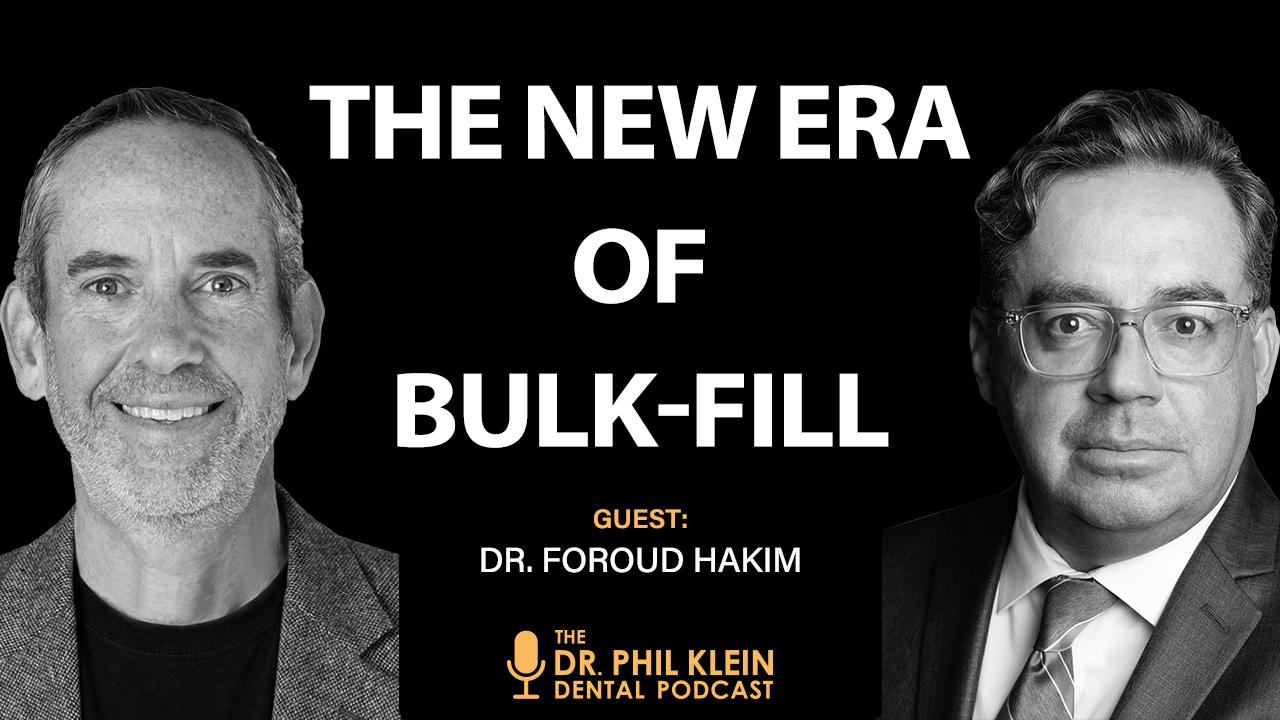
Episode 815: The New Era of Bulk-Fill Composites: Simpler, Faster, Better?
 |
Are you still layering composite in two-millimeter increments? Advances in material science and photoinitiator chemistry may have made that requirement obsolete — and today's episode explains exactly why.
Dr. Faroud Hakim is a restorative dentist with over 30 years of private practice experience and more than three decades of dental education at the University of the Pacific Arthur A. Dugoni School of Dentistry, where he serves as Vice Chair of the Department of Restorative Dentistry and Course Director for Occlusion, TMJ, and Advanced Restorative Concepts. He is also a director of the Esthetic and Complex Care Clinic at Pacific, holds a DDS and an MBA from the University of the Pacific, is a fellow and graduate of the ADEA Leadership Institute, and is a member and past president of the OKU dental honor society. A nationally recognized lecturer and author of two chapters in the textbook Esthetic Dentistry in Clinical Practice, Dr. Hakim also serves as a clinical evaluator for emerging restorative materials, making him a uniquely credible voice on the real-world performance of modern composites.
In this episode, Dr. Hakim joins Dr. Phil Klein to break down two of the most significant trends reshaping direct composite restorative dentistry: bulk-fill materials and shade simplification. The conversation covers the materials science behind polymerization shrinkage, light penetration, and the evolution from halogen to LED curing — and explains how these advances have redefined what is clinically achievable in a single placement. Dr. Hakim also addresses the role of adhesive technique, isolation strategies, and composite injection molding as both a diagnostic and definitive treatment tool.
Episode Highlights:
- The traditional two-millimeter incremental layering rule was not arbitrary — it addressed three simultaneous material limitations: polymerization shrinkage, inadequate light penetration depth, and the need for three-dimensional color stratification. Advances in stress-relieving resin chemistries, improved collimated LED curing lights, and broader-spectrum photoinitiators beyond camphorquinone have collectively enabled modern bulk-fill composites to achieve shrinkage at four-millimeter depths equal to or less than what was previously achieved with two-millimeter increments.
- A visual transformation technology incorporated into one current bulk-fill composite addresses the longstanding trade-off between translucency for light penetration and adequate optical opacity for aesthetics. The material appears highly translucent in its uncured state — allowing full light transmission to the pulpal floor — and then becomes trans-opaque upon curing, mimicking the optical behavior between dentin and enamel and producing a chameleon effect by drawing color from adjacent tooth structure. Cure times are as short as 10 seconds per four-millimeter increment for lighter shades, with the darkest shade requiring 20 seconds.
- Shade simplification has progressed from single-shade omnichromatic systems — which address approximately 70% of clinical cases — to five-cluster shade systems spanning the breadth of the classic Vita shade range, estimated to address approximately 95–96% of teeth. This approach reduces inventory burden while preserving the aesthetic range needed for anterior and posterior restorations, with specialty opacifiers and tints available as supplemental options for highly technique-sensitive cases requiring advanced stratification.
- Radiopacity in composite restorations carries direct diagnostic and surveillance consequences. Highly filled modern bulk-fill composites are now available with radiopacity ratings of approximately 900% aluminum equivalent — roughly three times higher than conventional composites — allowing clear differentiation between restoration margins and tooth structure on follow-up radiographs, particularly critical at the gingival floor of proximal boxes where recurrent caries detection is essential. Using a flowable liner with lower radiopacity at this margin introduces a diagnostic compromise that can be avoided by warming the body composite to achieve adequate adaptation without sacrificing radiographic visibility.
- Endodontically treated posterior teeth do not universally require full-coverage restorations when sufficient coronal tooth structure remains. The decision should be driven by the volume and quality of remaining buttress tooth structure, the patient's occlusal load, and the clinician's ability to achieve ideal bonding conditions — including appropriate isolation and adhesive technique capable of achieving bond strengths in the range of 40–70 megapascals. Composite injection molding offers a clinically validated alternative for full-arch rehabilitation that can serve as a diagnostic tool for occlusal testing, an intermediate restoration while staged crown and bridge work is completed, or in select cases a definitive restoration.
Perfect for: General dentists looking to update their direct restorative protocols, dental residents and new graduates building foundational composite skills, and any clinician seeking evidence-informed guidance on bulk-fill materials, shade selection, and post-endodontic restorative decision-making.
If you have ever second-guessed whether a bulk-fill composite can truly deliver on its clinical promises, this episode gives you the science, the technique, and the clinical context to make that call with confidence.
Disclaimer
Viva Learning LLC sites offer content that include opinions, techniques, recommendations, etc. from a variety of writers and speakers that are not necessarily endorsed by Viva Learning LLC, its associates and sponsored Viva Affiliates. Viewers are responsible for verifying the validity, accuracy and relevance of all content before implementing any techniques, products or recommendations into their clinical setting. Viewers understand that Viva Learning LLC, its associates, writers, speakers and sponsored Viva Affiliates are not in any way responsible or liable for any adverse events that may occur (i.e., in a clinical setting or anywhere) based on any information disseminated from Viva Learning LLC sites, including all Viva Learning sites.
The copyrights and other rights to the slides and video contained in a webinar posted on this website are owned by the speaker, Viva Learning LLC, and/or the sponsor company and/or its subsidiaries worldwide. Viewers are only authorized to view the content of the webinar (live and archive) at this Website and are not permitted to screen capture, record and/or download any content displayed in this webinar. You may not make any part of this Website available as part of another web site whether by hyperlink framing on the Internet or otherwise.
The copyrights and other rights to the audio contained in a Viva Podcast are owned by Viva Learning LLC. Viewers are authorized to listen to the content of the podcast and are permitted to download any podcast for personal use only. You may not, however, make any part of this Website available as part of another web site whether by hyperlink framing on the Internet or otherwise.
By signing up for a free webinar and/or podcast you give Viva Learning LLC and/or its Viva Learning Affiliates permission to send you emails alerting you to future CE opportunities and e-learning content.
California State Dental Board Provider Statement
Viva Learning is a registered continuing education provider in the state of CA. Dental Board of CA Provider #RP 5747. Approved through 6/30/2026
Questions regarding our Conditions of Usage, Privacy Policy, or other policy related material can be directed to our support staff by clicking on the "Support" link or you can email us at: support@vivalearning.com.
Approval does not imply acceptance by any regulatory authority or AGD endorsement.
Approval period: 11/1/2025 - 10/31/2029. AGD Provider # 217544
Presenter Information: Dr. Foroud Hakim
 |
Dr. Hakim has balanced private practice and dental education for over 21 years in the San Francisco Bay Area. He has a true passion for restorative dentistry ranging from complex rehabilitation to optimal and conservative single tooth restoration. He is Vice Chair of the Department of Restorative Dentistry at University of the Pacific and is course director for “Occlusion, TMJ & Advanced Restorative Concepts”. He is also a director in the “Esthetic and Complex Care Clinic” at Pacific. Dr. Hakim has lectured nationally in many venues including seminars, continuums and hands-on-workshops on topics ranging from technology, esthetic dentistry, occlusion, smile design, CAD/CAM, photography, and adhesive and composite dentistry. Dr. Hakim has several publications and has authored two chapters in the 2010 text, “Esthetic Dentistry in Clinical Practice” from Blackwell Publishing. Dr. Hakim earned his DDS in 1991 from Pacific and later went on to complete an MBA from his alma mater. He is a member of OKU dental honor society and past president of the Delta Delta Chapter. He is also a fellow and graduate of the ADEA Leadership Institute class of 2007. In his free time, he enjoys spending time with his wife Mana and two kids Ash and Tara, traveling, golf, fishing and competitive team sports. |
Viva Learning is an approved AGD PACE Provider and California State Dental Board Provider of dental continuing education. Viva Learning strives to deliver balanced, objective and clinically relevant information grounded on scientific research. Lecturers who are invited to deliver Viva CE webinars are advised to substantiate their claims with research-supported data and to disclose all commitments to, or relationships with, any commercial entity within the dental industry. In many cases, lecturers are sponsored by a dental manufacturing company, which provides them with support in the form of honorarium and/or dental products and equipment in order to help with clinical presentations. Prior to each live CE webinar, lecturers are made aware of the importance of delivering their presentations without commercial bias, and where appropriate, to mention a variety of different product choices that may be relevant to the subject matter of the lecture, for the educational benefit of the participant.
Transcript
-cluster-shade system is going to have 95%, 96% of the teeth addressed. So that's going to cater
to most of the doctors out there.
Welcome to Austin, Texas, and welcome to the Dr. Phil Klein Dental Podcast. For decades,
the prevailing orthodoxy in dentistry was that composite restorations should always be placed in
two-millimeter increments. But advances in materials science have challenged that long-standing
belief. Today, we'll explore what those advances mean in everyday clinical practice,
along with other key considerations for direct composite restorations, including handling
characteristics, radiopacity, adhesion, and practical tips for composite injection molding.
So if you're a general dentist who enjoys restoring teeth with composite, you're going to
appreciate today's guest, Dr. Faroud Hakim. He shares insights drawn from more than 30 years in
private practice and working with residents at the University of the Pacific School of Dentistry.
Also in this episode, he offers some thoughtful advice for new graduates, emphasizing that
investing in high-quality continued education immediately after dental school is one of the best
ways to accelerate your clinical skills and confidence. Before we get started,
I'd like to thank all of you for tuning in. If you're enjoying the show, please follow us on Apple
Podcasts and Spotify, and even better, leave a review. By doing so, you're not only showing support
for what we do here, but your reviews are instrumental in getting more dental professionals to
listen and benefit from our content. We really do appreciate it. Dr. Hakim, welcome to the show.
Hi, Phil. Thank you so much for having me again. Yeah, we're very happy to have you. And we know
your schedule is pretty busy right now. So I'm glad you had the opportunity to come on. So all the
rage with a lot of the key opinion leaders that are out there speaking is digital dentistry. They
talk about the new gadgets, the new technology, AI. That's the exciting stuff. But there's also
been huge innovations in what we do every day, the bread and butter of direct restorative
materials. And two of the biggest trends that I've seen in composite dentistry, have been in bulk
fill materials and also shade simplification, which is the topic of today's episode.
To begin this episode, let me ask you this. What clinical challenges were manufacturers trying to
solve? What were they trying to overcome in respect to these two areas, bulk fills and shade
simplification? And how close are today's materials to delivering on those promises?
yeah phil you know both of these concepts bulk filling and shade simplification speak to the
manufacturer's kind of continual efforts to provide solutions for some of these pain points these
are pain points that doctors consistently articulate about their bread and butter day-to-day
routine restorative delivery one is please make my procedures more efficient more predictable give
me some tools to improve my roi while simultaneously improving the aesthetic outcomes And we've
seen incremental gains in the product development over these fronts, on these fronts, but I think
we finally have some pretty complete solutions. Do you agree that composites are somewhat under the
radar as far as how much advancements have been taking place in the composite world? Because, as I
mentioned earlier, the digital revolution is kind of overriding that? Absolutely. There's been so
much effort to improve and perfect composites, but people are creatures of habit.
They find a composite that they learn. and work with successfully, whether it's what they learned
in school or what they adopted after a class. And it's hard to lose track of how much better the
modern composites are and the potential improvement into your day-to-day outcomes you could make
by jumping to the next. mode of improvement or new scientific development. Yeah.
And I'm glad we have you on the show because you're an evaluator of some of these new products. And
that's important because when your hands are right on the new stuff and you can test it and give
your feedback, you're a good person to interview. So one of the big advancements and one of the
misconceptions that have been clearly refuted is the two millimeter increment concept.
For years, we've been saying when you fill a large restoration with composite, you layer in two
millimeters, you light cure, throw another two millimeters in, light cure, and so forth. Where did
that recommendation come from? And what advances in material science have allowed some of the
modern composites to safely challenge that longstanding rule? Sure, yeah. That painstaking
incremental two millimeter layering that we were all trained under was necessary.
The reality was it was a material limitation. And so by layering at two millimeter maximum
increments, it allowed us to address three different things. One is shrinkage. Composites by nature
are formulated from a mix of glass fillers and a resin matrix. The heavier we make that volume
skewed towards the filler and less the resin, the less shrinkage. But that can only go so far. So
the bad things with shrinkage means that you fill a cavity, a hole, with the paste of composite.
And theoretically, it fits everywhere well. But as soon as it's polymerizing, it shrinks. When
something shrinks, it's no longer the same size. Gaps can form. You can get leakage, recurrent
decay, stain. Or worse, it could continue to stay adapted and bonded because of your bonded
interface. So now it puts a lot of internal strain, which is that shrinkage stress. So now you're
pulling cusps together. There's internal potential for fracture. All these things could lead to
sensitivity or premature failure. Then the other thing you were trying to overcome by layering is,
hey, our lights couldn't penetrate all the way down to the bottom. So who cares how well you've
cured a composite up top? If we have under-prolimerized composite at the lower interface, that
leads to a whole host of failures. Yeah, you're talking about the early halogen curing lights.
Exactly. And so in addition to that, layering gave doctors the ability to start to mess with three
-dimensional color and try to make the composite look more like a tooth and more real because,
let's face it, teeth, are not what uniform substrate. They're dentin and enamel with various
opacities and translucencies. So mixing that up with the composite gave them a tool, gave us a tool
to do that, but it was challenging. There was a lot of work involved in it. It was complex. We now
have more advancements in stress-relieving resin chemistries. We have better collimated LED curing
lights. That helps. And also the photo initiator, everything was camphorquinone. by itself and
that's kind of expanded into more advanced or broader spectrum type activators so initiators i
should say so these things put together have really helped i think reduce that polymerization
shrinkage like you're talking about so you think we're past the point now of worrying about the two
millimeter increment requirement or restriction out for a while the uh bulk fills came out at first
and they were jumping off point They had some benefits and they were making some grounds, but there
was some innate issues with them. One is what you said, the shrinkage. To get those stretchy
molecules, to get the stress reduction, they didn't necessarily hit on all points or cylinders
early on, but they had to start somewhere. And that's where the material science begins. A lot of
that shrinkage has been overcome to where now you can get a mass at four millimeters to shrink
equal or less than what our previous two millimeter increments would do. So that's great. And then
we can get light penetration based on the relative translucency of these composites, which is a
good and a bad. That was one of the other challenges. When something has to be more translucent to
allow light penetration, then afterwards it could wash out in a gray color and not be very
aesthetic. Staying with the topic of light curing and reducing polymerization shrinkage,
this one company, Voco, who we work with regularly, they are supporters of our show, and I think
you work with them as a consultant as well. They have a technology in their... Bocqueville that
really is, I think, a breakthrough as far as curing, and that's VTT, visual transformation
technology. And that's something I've never seen before in a composite. Maybe it's out there and
maybe I missed it. What do you think of this VTT? Yeah, this seems to be the answer to a lot of our
challenges, because like we said, if you have to have something that's a little bit... too
translucent, and at the end when it's rendered, looks a little grayed out. Well, that's not what
teeth look like. If we have something that has the trans opacity, if you will, of a natural tooth,
then maybe you're not gonna get complete polymerization or curing. This is what's unique about the
VTT technology. It allows for the composite when it's uncured. If I had a disc of it to place over
a white sheet of paper with a dark line underneath, I could actually see that dark line pretty
well. It would look very translucent. Soon as I cure it, suddenly it gets trans opaque. It has more
of a in-between a dentin and an enamel type behavior to it, the optics of it.
And so now we're getting that material as it's cured. The filler is pulling color from the adjacent
tooth, providing that chameleon effect, and yet allows the composite to fully cure down to the
bottom at a very rapid pace, 10-second increments of cure. Correct me if I'm wrong. With the
darker shade, A4, I think you may need 20 seconds because it's darker. Correct. Their menu has five
shades. All the way, the first four are all only 10 seconds for four millimeters. Only the A4,
because of the relative opacity, did they recommend a 20-second cure? Yeah, now sticking with that
Grandioso For You product, because that's an example of a real innovation in composite direct
restoratives, the shade matching. They've pretty much kind of grouped the entire classic V to shade
range into five shades. Now, how did they do that? This is, again, from...
feedback and evaluation from people in the know, the first company that really made marketing
headway or ground with this was a company that came out with a single-shade Omnichromatic
Composite, and we all know the name, Omnichroma. Tokiyama delivered it. It's a very good product
that really got the ball rolling. And if there's such a thing as oversimplification, that may be
what happened because they basically looked at doctors and saw that 80% almost of the sales of
composite out there were A2. So no matter how complex shade systems were, so many would gravitate
towards the mean and buy a medium shade and put that everywhere. And that worked if your tooth was
A2. So if you come up with a composite that has that capacity to chameleon against the tooth,
they were starting to get to the next shades adjacent to it pretty well, A3, A1. But as we start to
diverge further from that centralized shade, that uniform single shade approach,
as we get to the outer end of the spectrum, or if we have a dark background, or we don't have
adjacent tooth structure, That's kind of where a single-shade composite starts to fall short.
Voco looked at this and said, hey, how can we kind of answer everybody's prayers, make the best
aesthetic possible, and still reduce inventory? And that's where this five-cluster shade system
was born. So they created the chemistry of the composite where they clustered various shades and
then consolidated into basically five shades, A1, A2, A3. I think they have A3.5 and then...
a four correct correct and how is that working for you aesthetically in the social six i think it
basically answers almost everything we're looking for. If a single shade system maybe gets 70% of
the teeth addressed, somebody working with this five cluster shade system is going to have 95, 96%
of the teeth addressed. So that's going to cater to most of the doctors out there. Are there a few
of those one percenters that are doing A, C, D level work? They're not under the time crunch.
They're not working in an insurance format that say, I want specialty opakers and tints and
translucent shades, and we're putting things a large print and publish. Yeah. Those people can
still benefit from this system, but they can buy a few specialty additives to it as well. But this
really is pretty darn novel, elegant solution for most of us.
Aesthetic zone and the functional zone for that matter. Right. Aesthetic zone and the functional.
So basically it's a true universal anterior, posterior for most of us, except the ones you just
talked about. Now, one of the things that as an endodontist myself, I think is critically important
is radio opacity. Composite resins have not been the most radio opaque.
The early versions had very little differentiation between the actual composite and dentin,
right? So... you know, you didn't really know what was going on in certain cases. You thought you
had recurrent decay, but it was actually filled with composite. This particular one by VOCO,
and it's really hard to believe, is 900% aluminum equivalent radio opacity.
And just so our audience understands, I did talk about this on a previous episode, that 900%
aluminum equivalent means that if you're placing a composite that's four millimeters thick,
to get an equivalent opacity, Using aluminum, you need a piece of aluminum 36 millimeters thick.
That's a significant increase in opacity for a composite, considering many of the traditional
composites, you know, were 300% aluminum equivalent. This is three times the opacity,
which is a big thing for diagnostic purposes. Absolutely. Not only do our composites have to look
good, not only do they have to function appropriately, which means hold up to the stresses of
chewing and food and hot and cold and strain and all those things, we have to be able to be
vigilant on surveillance, on follow-up radiographs, things like that. We've got to be able to see
the gaps, see where the tooth begins and the composite ends. And the more limited the radio opacity
is there, we're doing guesswork. We're wondering, where does the composite end? Is there a little
leakage? what's going on, especially if you're using mixed substrates and some flow bowl and some
body composite. Maybe you're not an old soul, but it's so gratifying to look at these x-rays and
it almost looks like amalgam. I don't miss amalgam, but I like the way that there was no guessing
where the amalgam ended and where the tooth began. And this is such an easy composite to monitor on
radiographs. Another thing that's really important is strength and resistance to wear. And back in
the day, not even that long ago, Bulk-filled composites or universal composites were 60% filled,
right? And that was considered pretty strong. Now, this one that we're focusing on, Grandiose for
You, is 91% filled. That's a real tough, strong composite. But the handling characteristics you
would think would suffer from that. But what I'm hearing from other KOLs, key opinion leaders like
Dr. McMahon and a dozen others, They're saying that it's creamy in consistency,
even with this ridiculously high fill rate, 91%. I mean, even you were probably surprised when you
saw that it was that highly filled. Absolutely. Handling is such a person-specific taste or
nuance, but we kind of universally agree that when something is just so slumpy and runny and sticky
that it's not fun to handle. And when something is so hard, like it came out of the freezer, it's
not easy to handle and manipulate and shake. That in-between ground is a sweet spot,
and everybody's sweet spot's a little different. But normally when you have something filled at
91%, which really, by the way, improves the material characteristics, how well it holds up to
occlusion, the edge strength, the hardness, the fracture resistance, the stain resistance,
polishability, all those things go up. But when they go up, sometimes the handling would suffer.
This actually falls kind of smack dab in the middle of the spectrum. It's just got the right
perfect handling for me personally. And if somebody wants something a little softer, it's easy
enough to warm up. If somebody wants something a little firmer, it's easy enough to cool down. And
so it's not by any means difficult to handle. It kind of falls right in that middle ground that
most people like. Certainly not sticky to instruments either. Do you typically warm your composite?
that's becoming more and more popular. Absolutely. I don't warm for every restoration. It depends
on whether I'm injection molding the composite or if it's an early cold morning and it's coming out
of the fridge, for example, or things like that. I will warm the composite sometimes. And
certainly, if you choose to use a flowable composite, and I'm sure Voco's probably working on this,
they're probably coming out with a version of the Grandioso for you for flowable. But if you choose
to use a flowable composite as your base layer, Well, it's not going to have the 900 scale alumina.
It's going to be visible, but you'll see a different gradient there. So a great way to do that is
to warm your composite. Now you're grandiose, so forth. You become semi-flowable, and it really
has perfect adaptation at that gingival floor or the box. And so you can have that consistent
appearance. throughout the entire composite restoration on a radiograph. When you're doing a class
two and you're using a flowable and you lose that radiolucency, that's an important compromise.
That's a significant compromise because that's where you absolutely want to see that you have radio
opacity to make sure you don't have recurrent decay there. Do you use any glass ionomer or
reinforced glass ionomer in your direct restorative work? I reserve it for the select cases where I
can't get perfect isolation, or where the bio-benefit,
I'm doing air quotes now, where the bio-benefit value is so much higher compared to the host
patient and what we can get out of their surveillance and long-term care and things like that. So
I'm probably, the composites these days are so good, if you're in a practice where you're regularly
seeing your patients on recall, you're not going to be at a good composite restoration. Somebody
that's going through chemotherapeutics, doesn't have great hygiene, is going to be able to not come
in as often in an area on a root surface where you can't monitor. And sometimes places like that,
some of those bioactive restorative materials have a benefit, despite the reduced mechanical
characteristics. No doubt, Dr. Hakim, you're a strong believer in composite restorative, but it
also requires, like you mentioned, good isolation. And you need a really good adhesive system and
you need good adhesive technique in order to get your composite material to perform up to what the
specifications are on that particular material. Because if you don't have the adhesion and you
don't have the technique and you don't have the isolation, you're going to lose out on all the
promises that that manufacturer is making regarding that bulk fill. Absolutely. Your adhesive bond,
if it's done correctly, it's going to be insurmountably stronger than a chemical bond. So if you're
committed to doing that, the composites will... you a far better outcome restoratively. If you have
a patient that's a compromised interface and a patient that maybe is compromised as far as their
care and regular recall, then something that gives you a little bio-benefit tips a needle in that
direction compared to something that has maybe better mechanical strength. Yeah. Now, when I was an
endodontist back in the day, I don't want to tell you when I was practicing, but it wasn't that
long ago, but everything is relative. But it was typical that a GP, when they referred me the case,
I did the root canal and when I sent it back to them, especially on a molar, it inevitably was
treatment plan for full coverage. And the idea was, you know, that... tooth was going to become
brittle. The access prep weakened the inside of the tooth because we went all the way down to the
canals. But today, I speak to a lot of dentists that don't do full coverage just because the
endodontic case has been completed. Because with these new bulk fill composites and the adhesion
that you're talking about, you can get an extremely strong tooth without having a crown.
Or what's the new term for it? A crown lay. Have you heard that? A crown leg.
Overlay, yeah. Overlay, yeah. So these young dentists are changing. They'd love to change the
jargon, which that's great. We call them crowns. What's your thought on that as far as an
endodontically treated tooth and to go straight to full coverage on a molar or bicuspid?
Yeah, you know, these things sometimes start to take the kind of position of kind of religion and
popularity or what have you. Politics, but really it all comes down to physics. There's no mystery
about it. The more of the quality buttress parts of the tooth that you violate,
the more likely it is to break. So a conservative access on a tooth that died for whatever reason,
but not because it had a giant MOBDL amalgam and three quarters of the tooth is gone.
With good internal bonding and splinting potentially could last a long time and you could just
leave it with your final composite fill. But you look at the patient's occlusion, and if they're
very hard and all their teeth have craze lines and crack lines, even when the tooth is not
destroyed down into the proximal boxes, sometimes you would consider an overlay to link the cusps
together and keep that tooth from further spreading. And you can kind of look at the tea leaves on
the patient, look at their other teeth and decide, hey, what are the forces that we are challenged
with here? Certainly, even when you have to provide cuspal coverage because the existing
restoration wasn't just the endoaccess. There was the old MOD that was taken out. You don't always
have to migrate your margins down to the gum line because that same bonding that we use for
composites we have available to us for our final overlays, crowns, inlays, onlays. So you can
preserve the good parts of Mother Nature has left you, the valuable enamel and dentin that's not
damaged, and just simply lower your margins to get past the lowest stage of your buildup. Because
we have bonding. We don't need nice tall walls for retention and resistance anymore. So you pick
and choose. There's a variation of crowns. They don't look the same. And some of them can be flat
top overlays. And sometimes we can get by with just sealing the access with a well bonded
composite. Yeah. Now, do you talk about this with the patient prior to sending them to the
endodontist and let them know that, you know, we're going to send you for endo on this, but this is
the rest of your treatment plan that we are considering. And you have some choices here. Is that
part of the discussion? A hundred percent, depending on the patient's appetite for how complex the
conversation needs to go. Some of them will just say, you know what, fix it, I trust you, do what
you think is necessary. Other ones want to know, and especially the engineer types, I share with
them how we're trying to preserve their tooth structure, not waste the good, but cover up the bad.
And so it's a very, it's a good conversation to have because it starts to build rapport and trust
with your patients where they're confident you're doing what you think is best for their teeth.
Yeah, I spoke to a dentist on this show from Ohio and his clientele is,
it's a blue collar neighborhood. They don't have tons of resources, these individuals, his
patients. But he found 30 years ago, 25 years ago, that he would have the endo done by an
endodontist. The patient would come back. or he would even do the endo, and let's say it was a 12
-year-old, a young person, rather than prepare that tooth for a crown, they didn't have the
resources to do it anyway, he would do composite bulk fills in there. And that's when he started to
realize the power of direct restorative composite material, that it could be so powerful with the
right adhesive chemistry. He was convinced just by all these cases that he saw, you know,
five years, 10 years, 15 years later, they looked exactly how he put them in. So his technique was
meticulous. And he actually believes that, it's not even believing, he hardly does any crowns.
Even teeth, you know, not the ones that are just, you know, flattened down on the gum line. But
generally speaking, they could be missing cusps and they could be old amalgams where there's very
little left. He will bond to that remaining tooth structure. and carve up a tooth out of composite
resin with all the adhesive dentistry that he does. And he says his results are just phenomenal.
Yeah, that's actually a great conversation for a whole other podcast, but it all comes down to
adhesive technique. If we're getting 20, 30 megapascals of bond strength,
that's reasonable. We can get our restorations to last. But somebody that's seeing badly broken
down teeth, restored with purely composite, that's getting 10, 15 years outcomes, I guarantee you.
getting more like 40 or 50 or 60 or maybe 70 mega pascals of bond strength and how how is he
getting that bond strength so high so some some adhesives do it but a lot of it is the right
adhesive the right technique and placement that has to be meticulous and honestly good composite
bonding is not for sissies you got to follow the instructions do it well yeah i mean that's the
whole thing that's the kind of discussion that i've been having um and i've been gleaning that from
KOLs like you and clinicians that work every day in the field. What kind of isolation do you think
is necessary to maintain that kind of adhesion for these things to last that long and obviate the
need for full coverage? Yeah, you have to have ideal isolation. You can't have any contamination.
And so a gold standard is rubber dam. But now, you know, rubber dams have a bad rap because it
takes a while to put on. Honestly, people can't wait to run away from them after school. But
finally, over the last decade or so, there's rubber dam alternatives that work pretty darn well.
Each of them have a nuance. You have to know how to integrate them into your practice. But things
like the IsoDry, the DryVac, the Isolite, there are OptraGates, umbrellas, they sometimes work
better in certain parts of the mouth. So being able to look at the target and figure out which
system is the best to isolate, it still takes into mind the economics of practice and how quickly
we have to get patients in and out. takes in consideration their comfort level and what they want
to be put through. There's never a reason to really compromise in my mind isolation because there
are effective solutions for it where you can still get the best bonding. Yeah. You said you did
injection molding. Is that for veneers? Yeah. And there's variations on injection molding as well.
But whether it's for direct veneers, whether it's for an intermediate long-term rehabilitation as
staging. Rather than putting somebody in a segmental splint, I can do a full mouth rehab with
injection molding that becomes an intermediate restoration and allows somebody to break up their
multiple units of crown and bridge and overlays and onlays over the course of a few years. It can
be a testing for occlusion. So there's so many variations where approaches like injection molding
or there's variations to injection molding now can be good for final restorations, for intermediate
restorations. It really has become both diagnostic and a treatment tool. Yeah, no, that makes a lot
of sense. Yeah, that makes a lot of sense, Tartar Kim. What do you do? Scan the mouth and then you
design it digitally? You do a digital wax up? and then you create you can do both you can do you
can do analog and sometimes because the magic is how well it seals at the gum line and how thin
that fin is to minimize finish time sometimes a good old-fashioned compression hydraulic vps gives
you a better some of the machine averaging when you scan at the gum line where it doesn't get
around undercuts has some variabilities doesn't mean you can't do it digitally but just means a
little bit more finishing how well the wax up is done, how well that injection molded clear matrix
is made. All these things lead to, and there's a big learning curve to it, but leads to you having
less finishing to do and better adaptation of the gum line, which is always the finish part of it
at the end. It makes your life easier. So you can do it analog or digitally. It's really
understanding the principles. So what do you do? Feel sorry for these new dentists coming out that
don't have any of your experience, that have to go through the same mistakes that you've gone
through in the last two or three days? How long have you been practicing? How many? Since 91. So
35, 36 years now. Right. Now think about all the things that you do on a patient or don't do
because you know that it's going to make things worse. And what you do do to make things easier
down the road, like you said, easier finishing, just everything that you do clinically.
It takes a decade, right? At least, what do you think? A decade to get most of these under your
belt? It depends on your appetite. Those that know that they don't know and are willing to go to
the right courses in CE rather than just using Instagram to educate themselves, get there faster.
Those that have a mentor that they work with, get them faster. Some never get there. But as you
know, right now I'm coming to you from the dental school. So I practice a couple of days a week and
I teach the other three days a week. So I see these graduates and I've taught since 91. So I have
something around 6,000 graduates underneath me. Wow. And these four graduates,
when we were students, we had a certain number of things. And if you got good with your hands and
you learned how to be a good technician, you were a reasonable dentist. In the last 35 years, we've
eliminated gold foil and reduced a little bit of amalgamation education. But we've added digital,
we've added CAD CAM, we've added Keriology, we've added Canberra, we've added injection molding,
composites, implants, ortho. They have so much added, but we haven't added educational time.
It's still four-year programs. And the dental hygiene programs are going through the same thing.
Do you have anything on lasers in dental school now? We do, but all of it, touch points, lasers,
photography, they basically barely get exposed to it, where when I was a student,
if we learned about Crown and Bridge, we did a huge number of crowns, we did our own lab work, and
we got... good at it. So we were safe beginners. Now they get kind of 20,000 foot touch points on
everything. They don't get enough iterations. So it's really incumbent on them to continue to learn
afterwards, take the right courses, get in the right study clubs, read the right journals, take the
right seat. go to the right continuums, listen to your podcasts, all the things they have to do.
Well, no, I mean, yeah, I appreciate that. But it really is a different world out there now than
when we got out of dental school. But they do have the digital workflow in dental school, right?
They have all the gadgets to scan. They have the intro scanners. Do they have 3D printers? Do they
have like design software that they work on? They have all of it. They have all of it. And they
just learn just enough to have an entry point to it. which means those additional courses and
coursework compete with a lot of the other things that have to be learned as well. So all of it is
kind of brushed over because we have no other choice. So what's the solution, going to a five-year
program? Yes, which the economics won't vet out anytime soon. At Pacific, we're the only three
-year program. It's very desirable, even though we do cram four years into three. But for example,
New York said that, hey, everybody that wants to practice in the state after dental school has to
have a mandatory fifth-year residency. Yeah. So more and more students now are going to a fifth
year via GPRs, AGDs, residencies, things like that. So University of the Pacific is a three-year
dental school? It's a three-year dental school, but it's still 12 quarters, same clock hours, same
number. So you just get shorter breaks. I see, I see. So it's even more congested, more compacted.
In closing, as we wrap up this podcast, it's been a great conversation, Dr. Hakim. Given the
situation we're in now at dental schools, we're squeezing more and more in the same number of years
that we've... the dental students decades ago. It's packed with new things.
A lot of their clinical experience consists of, like you said, 20,000 foot touch points with
minimal iterations. They certainly don't get out of dental school with any kind of expertise where
they can feel confident doing some of these procedures in private practice. In light of all this,
what is the best path based on your recommendations, Dr. Hakim, for a new graduate? dental school.
And in some ways, this pertains to the dental hygienist as well. Yeah. For those that have the
luxury of going into a private practice with a senior doctor that can be a mentor, that's well
-trained, that's committed to continually learning, that's great. Many won't have that option.
If you have that option, embrace it. For those that don't, keep going to CE, but also become a good
CE consumer. Every CE is not good and you don't necessarily know what's good or bad to you. overpay
for some and realize that it didn't quite deliver on the promise. Some of it's marketing or what
have you. Go to CE, read, ask your peers, join study clubs, get on forums, get on the forums that
are more educational and science-based rather than social media forums where they're just
marketing and clickbait types of forums. And the biggest thing is be humble and know that there's a
lot of learning that's still left. be done. Great advice, Dr. Hakim. We really appreciate it. And
I think it's really important for our listeners to be vigilant when it comes to selecting a CE
program, any program, even if it's a half a day, make sure you get reviews or opinions from other
dentists that have taken it. And this way your money will be well spent and your time won't be
wasted. Great discussion, Dr. Hakim. We're always very happy to have you on the show. You have so
much to offer. We hope to have you on again soon and have a great evening. thank you so much phil
talk soon
 Episode 815. The New Era of Bulk-Fill Composites: Simpler, Faster, Better?
10/26/2026 - CE Credits: 0.5 CEU (Take Exam)
Episode 811. Implant Maintenance Update: New Evidence, Better Outcomes
10/12/2026 - CE Credits: 0.5 CEU (Take Exam)
Episode 807. Master the Social 6 with Injection Composite
9/28/2026 - CE Credits: 0.5 CEU (Take Exam)
Episode 803. Universal Composites with Dr. Marc Geissberger: What Dentists Need to Know
9/14/2026 - CE Credits: 0.5 CEU (Take Exam)
Episode 770. Mastering Pulp Therapy and Perforations with Modern MTA
5/18/2026 - CE Credits: 0.5 CEU (Take Exam)